
FEATURED HEADLINES
Food: Vegging Out
FEATURED FOOD
Vegging Out
Annual Vegan Festival Features Lectures, Vendors & More
Written By Angie Sykeny (asykeny@hippopress.com)
Images: Stock Photo
For vegans looking to connect with likeminded people or anyone interested in learning more about the vegan lifestyle, NH Veg Fest will feature a variety of lectures, demonstrations, vegan food vendors and more.
The annual festival takes place Saturday, April 22, at Manchester Community College.
“It creates a community,” event cofounder and coordinator Kathy DesRoches said. “A lot of people have families and friends who will say, ‘Just eat a piece of ham, it won’t kill you,’ so it’s easy to feel alone as a vegan. [Veg Fest] gives people the information to make decisions based on their values, and then a place to meet others who share those values.”
There will be four one-hour lectures starting at 10:30 a.m., covering topics like vegan nutrition, environmental impacts of animal agriculture, how to navigate personal relationships and wellness as an animal advocate, and how to cultivate an ethics of dialogue in social movement practices.

Four one-hour demonstrations will also begin at 10:30 a.m.; the topics will be vegan nutrition, vegan cooking, brewing kombucha and growing microgreens.
“I think the educational part is important,” DesRoches said. “There will be a lot of information about the body and being vegan, and it’s taught by nutritionists and experts, so you can ask questions and talk to people who know what they’re talking about.”
There will be more than a dozen vendors like Willow’s Plant-based Eatery in Concord and Susty’s Cafe vegan eatery in Northwood, serving soups, seitan and tofu sandwiches and flatbread pizzas; HippieCakes, a vegan bakery and dessert business opening a retail location in Raymond later this year; Taco Party food truck from Massachusetts, serving vegan Mexican cuisine like sweet potato tacos; and Like No Udder vegan ice cream truck from Rhode Island, serving soft-serve and hard ice cream, ice cream novelties, floats and shakes, all made with soy, cashew, coconut, almond and peanut milk bases.
“It’s a good chance to try out all kinds of different vegan foods in one place,” DesRoches said.
In addition to the educational programs and food vendors, NH Veg Fest will feature live music all day, drum circle workshops at 10:30 a.m. and 1:30 p.m., and Veg Speed Date — speed dating for vegans and vegetarians — at noon and 1:30 p.m.
DesRoches said the festival is a welcoming, family-friendly environment, and that non-vegans should not feel intimidated to come learn, eat and enjoy the various activities.
“We don’t judge,” she said. “If someone isn’t vegan that’s fine, and no one will mind. We’re just happy to have people come, hang out and have a good time.”
NH Veg Fest
When: Saturday, April 22, 9 a.m. to 3 p.m.
Where: Manchester Community College, 1066 Front St., Manchester
Cost: Free admission
Visit: nhvegfest.com
News: Forest Adventure *
FEATURED NEWS - * COVER STORY *
Forest Adventure
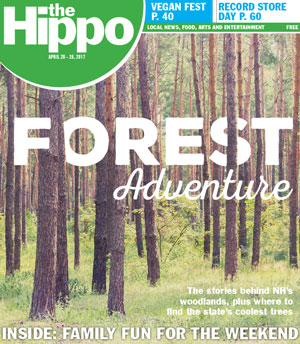
The Stories Behind NH's Woodlands, Plus Where to Find the State's Coolest Trees
Written By Ryan Lessard (news@hippopress.com)
Images: Courtesy Photos
With 84 percent of our state covered in forests, New Hampshire is the second-most forested state in the nation after Maine, according to the state Division of Forests and Lands. That’s about 4.8 million acres of land, with an estimated 4.2 billion live trees — and much of it goes regularly unexplored.
The state’s greenery and forest types vary from one place to the next. Some forests even have hidden treasures, from rare plant species to ancient trees.
Forest Types
New Hampshire’s forests are broken down into five major categories: Appalachian oak-pine, hemlock-beech-oak-pine (or HBOP), northern hardwood conifer, lowland spruce-fir and high-elevation spruce-fir.
According to Gabe Roxby, a field forester with the New Hampshire Forest Society, Appalachian oak-pine forests are only found in southern parts of the state and are relatively less common than the other forest types.
“New Hampshire is kind of at the northern edge of the Appalachian oak-pine forest type,” Roxby said.
It includes species like red oak, white oak, black oak, hickory and pine.
The HBOP forest type is the most common in the state and can be found in large swaths from the Lakes Region down.
Further north and in parts along the west of the state, you’ll find a higher concentration of the northern hardwood forests. These include the trees with the brightest color leaves during the fall foliage season, such as beech, sugar maple, yellow birch and other birches and maples.

Spruce-fir forests thrive in colder temperatures so they’re found in the northernmost parts of the state and at high elevations like in the White Mountains. For that reason, these forest types are divided into lowland and high-elevation categories. They include mostly red spruce and balsam fir. While these are mostly up north, one notable exception is the top of Mount Monadnock, according to Roxby.
Compared to other nearby states, New Hampshire’s soil is more acidic. Vermont soil, by contrast, is more balanced due to calcium released by more limestone in the bedrock, which makes it better for vegetation. But there are some places in New Hampshire that have richer, moister soils that provide a habitat for more herbaceous plant life. These are called “rich mesic forests” and they include places like Pawtuckaway State Park, Coleman State Park and Cape Horn State Forest (see page 15).
Different forests are also in varying stages of growth. Old growth forests, mature forests and transitional young forests known as “early successional” forests all exist in the state.
Right now, the state’s forests are in a period of significant regrowth and most forests are neither very young nor very old.
“A lot of the forests in our state have been cut over and cleared. Almost all of them. There’s very little old growth left in the state,” Roxby said.
While most trees are relatively younger, aged around 100 years on average, there are some notable exceptions. A few years ago, state researchers discovered the oldest tree found anywhere in eastern North America. It was a black gum tree (also known as a tupelo) aged about 700 years old. Pete Bowman, wildlife biologist at the New Hampshire Natural Heritage Bureau, said the tree is located with a few other ancient black gums in a swampy basin on private land in Deerfield.
Animal Life
The age and composition of a forest can affect what kinds of animals might take up residence in a forest. For example, some birds like Grey Jays or Spruce Grouse require spruce-fir forests and can’t be found outside of one. Lots of mammals require significant tree cover for their habitats, so as forests grow back, the state sees an increase in deer, beaver and bobcats. Other species like porcupine and turkey have been doing well as a result of a number of factors from conservation efforts to shifts in predator populations.
Canine species like gray fox, coyote and fisher have reached such high population numbers they are now being affected by natural population controls such as canine distemper.
But while some species thrive in mature forests, others prefer young transitional forests.
Forest historian Tom Wessels of Antioch University of New England said when abandoned farms in the state gave way to rebounding forests, it provided ideal habitat for species like New England cottontail, grassland bird species and warblers that need small, “shrubby” trees.
“Now, we’re seeing them really decreasing because we don’t have those those really early successional ecosystems much anymore,” Wessels said.
Making Way for Sheep
The current formation, age and composition of the state’s forests was largely the result of human intervention.
According to Wessels, there were two significant historical developments that shaped our forests, the ripple effects of which are still felt today.
The first big wave of deforestation in New Hampshire, and much of central New England, was to make room for sheep pastures, according to Wessels. But for a strange turn of history, this might have never happened.
Farmers in New England had some sheep already, but they didn’t produce very good quality wool. That changed when a diplomat from Vermont named William Jarvis performed an act of international theft.
In the early 1800s, Spain was exporting high quality wool from a special breed of sheep called merino sheep. They grow long hair at faster rates than other breeds and their wool could be woven into higher-quality garments known for being more water resistant and itch-free. Wessels said that while Spain sold the wool, they had an embargo on the sheep itself, hoping to hold onto their merino monopoly.
While serving as consul in Portugal around 1810, Jarvis took advantage of Napoleon’s invasion into Spain and smuggled 4,000 merino sheep out of the country through Portugal, according to Wessels. He even gave a few to his buddy Thomas Jefferson.
Around the same time, after the War of 1812, new tariffs on wool imports protected local wool producers from international competition and by 1814 the power loom was invented, allowing for mass industrial production.
Merino sheep were a sure money-maker for New Hampshire farmers. The only catch was land; sheep need a lot of it. The obvious solution was to clear out huge areas of forest. Wessels said by the middle 1800s, about 80 percent of the state’s forests were cut down, the bulk of them for sheep pasturage.
“It changes the landscape because it’s sort of the first large-scale market farming opportunity for farmers in New Hampshire. Up to that point most farms were self-reliant farms where people were growing enough food for themselves and if they had a little bit left over it would get sold,” Wessels said. “It vaulted the central portion of New England — which would have been all of New Hampshire pretty much south of the Notches — to become one of the major woolen textile producing regions of the world.”
The wool industry would experience ups and downs, usually caused by changes to tariff laws. From 1845 to the 1960s, Wessels said the state experienced a gradual period of farm abandonment, which allowed for reforestation.
“The bulk of our forests today are all generated from that farm abandonment,” Wessels said.
Ironically, almost all the trees cut down for pasturage wasn’t used for timber. They were burned. Farmers could still make money off of the ashes. Pot ash was a key export for making gunpowder and soaps back then.
Timber Industry
The second historical development that helped shape our forests today was a significant clearcutting operation that almost wiped them out altogether, especially in the White Mountains.
Wessels said timber was a key industry in the state even during colonial times, when the British would use our trees to construct their navy.

“Really the basis of the New Hampshire economy at the start was timber, because although New Hampshire’s soils were not as fertile as, let’s say, Vermont … New Hampshire soils grew really good pine and oak and both [were] valued for shipbuilding,” Wessels said.
The large pines were used for masts and the oak was used for framing. But those trees were cut selectively.
“They were going after the best trees and they weren’t really clear cutting,” Wessels said.
But by the late 1800s, the timber industry was clearcutting forests in the White Mountains, and it lasted into the 1920s. This gave rise to groups like the Forest Society, which sought to preserve the forests, and new federal conservation policies.
Another thing deforestation did was reduce forest diversity. Historical records suggest a much wider variety of tree species co-existed before the wholesale removal of forest areas, according to Wessels. Today, forests have become more homogenous.
New Hampshire’s State Tree
In a way, this clearcutting might have had a significant impact on which tree was chosen to be the official state tree. In 1947, the legislature named the white birch (also known as paper birch) the state tree. White birch is an early successional species and it’s not very tolerant of shade, according to forester Gabe Roxby. This means they thrive in open, sunny areas, but they struggle when tree cover gets too dense. Their boom in populations was a result of the clearcutting and its prevalence may have played a hand in the legislature’s choice.
“I wouldn’t doubt that the clearcutting of the White Mountains had a big impact on that choice because paper birch was one of those trees that came back like gangbusters after that clear cutting,” Wessels said.
Now, the white birch is in sharp decline, according to Roxby, who keeps track via the annual reports put out by the U.S. Forest Service.
Disease
A few other things have affected forest composition over the years. Bowman said the state used to have a lot more elm and American chestnut trees. Dutch elm disease was introduced to the region from diseased logs in the 1930s, according to the UNH Cooperative Extension. Chestnut blight did away with most of the chestnut trees in the region around the same time. The trees now can only grow to a point and die off to the roots, repeating this cycle, never to reach maturity.
The next big change in the state’s tree composition may be the loss of the ash tree. New Hampshire is home to white, black and green ash (white being the most common) but all are susceptible to a deadly invasive insect called the emerald ash borer. Ash have been wiped out in other parts of the country exposed to the beetle, so the state has attempted to slow its progress by banning cross-county transport of firewood, which ash borers can hitchhike on.
Environmental officials are also experimenting with different ways to fight back against the bugs, but the demise of the ash seems otherwise inevitable. “Ash doesn’t have a super bright future,” Roxby said.
Tree Terminology
Coniferous, softwood, evergreen: Often used interchangeably, most coniferous trees keep their foliage year round. They produce cones and most have needle-like leaves, such as pine, fir and spruce.
Deciduous, hardwood, broadleaf: These are the trees that lose their leaves seasonally. Their leaves are wider and their wood is harder. They include species like oak, maple, hickory, birch and beech.
12 Forests and Trees Worth Visiting
On April 8, dozens of families gathered at the 10th Annual Earth Day Celebration at the Massabesic Audubon in Auburn. The coup de grace was the release of a rehabilitated barred owl back into the wild. Parents and small children watched, fascinated, as the bird’s handler, Maria Colby with Wings of the Dawn, opened a large black box and, with a little coaxing, the raptor emerged and flew to the nearest tree cover.
For the bird, the forest is its home. For us humans, it can be a nice place to visit. But to those of us who are not regular hikers, it can be hard to switch off Netflix and go experience nature.
What we need is a purpose. To that end, here are 12 destinations to check out with various points of interest that make these wooded places extra special.
Pawtuckaway State Park: Located at 7 Pawtuckaway Road in Nottingham, this forest is unique from most other places in the state for a number of reasons. Pete Bowman, wildlife biologist at the New Hampshire Natural Heritage Bureau, said it’s one of the best forests for finding rare plants. “[Pawtuckaway] has some of the highest concentrations of rare plant species in the state because of its unusual geologic history,” Bowman said. He said the ground beneath the forest is what gives it its unique characteristics. The ring-shaped mountain formation within Pawtuckaway, known as a ring-dike, was the core of an ancient volcano. That lent the area richer soils because of the mineral nutrients released by the old volcanic bedrock. Some plant species need richer nutrient diets to survive. According to ecological inventory reports by the Heritage Bureau, most of the rare plant species in the park are found within the ring-dike. During surveys, Natural Heritage Bureau researchers found pockets of what are called “rich mesic forest,” which provide for a wide variety of herbacious plants. Some are common, like Christmas fern or red baneberry. Others are rare, like bur sedge, sickle-pod and climbing fumitory. In 2002, surveyors there found the first occurrence of Hitchcock’s sedge in the state. The dominant forest type in Pawtuckaway is a hemlock-beech-oak-pine (HBOP) forest, which is one of the more common forest types in the state. But there are also trees more commonly found in Appalachian oak forests. The park is always open for recreation but is only staffed full-time from May 1 through Oct. 31.
Coleman State Park: Located at 1166 Diamond Pond Road in Stewartstown, Coleman State Park is another rich mesic forest with excellent soils for growing a wide variety of plant species, according to Bowman. The ecological inventory of the park published in 2009 states the park is home to a number of rare species such as Goldie’s fern, squirrel corn and others. The forest is a northern hardwood and spruce-fir forest. The park is always open for recreational use and the operating season for the campground goes from May 5 through Oct. 16.
Cape Horn State Forest: Located in Northumberland, this forest contains a “rich mesic forest” that can support a number of rare plant species. The geology of the land balances out the pH and increases the nutrient content in the soil. The forest at the highest elevation is classified as a red pine rocky ridge community, which is dominated by red pine with the occasional red oak and red maple dotting the landscape. At lower elevations, in the rich mesic forest area, hardwoods like sugar maple and white ash dominate. Herbs like northern maidenhair fern and blue cohosh are common, as well as rare plants like Goldie’s fern, beaked sanicle and showy orchis. And in the basin near Dean Brook is a northern white cedar-balsam fir swamp, which also includes black ash. Herbs in the swamp include common species like small enchanter’s nightshade.
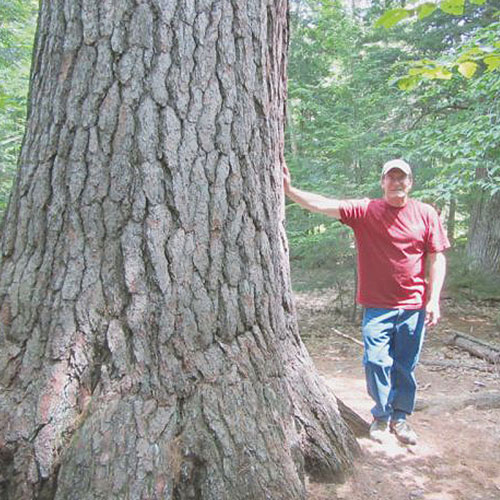
Tamworth Big Pines: The Big Pines in Hemenway State Forest in Tamworth are reachable by trails maintained by the Tamworth Conservation Commission, according to the Division of Forests and Lands. The trail starts at the parking area off Route 113 and it leads to some of the largest white pines in New England. To get there, travelers must walk over a wooden pedestrian bridge over the Swift River and a loop trail leads to the grove with the giant trees. Another trail that branches off the main trail leads to an observation tower at the top of Great Hill.
Madame Sherri Forest: Access Madame Sherri Forest through an entrance on Gulf Road in Chesterfield. Inside, you will find not one but four “exemplary natural communities” (the name used by the state to describe distinct and thriving forest ecosystems), an Appalachian oak-pine forest and the ruins of the titular mansion. The 516-acre forest is owned partly by the N.H. Forest Society and the state Department of Resources and Economic Development. The stone ruins are not a feature of a long-lost civilization, but a relic of a prohibition-era socialite who went by Madame Antoinette Sherri. The foundation and stone staircase is all that remains of her French chateau with Roman influences, which burned down in 1962 after Sherri became destitute and abandoned the property. Still, it might be fun for kids to imagine the ruins belonged to a fairy kingdom.
Biggest Bigtooth Aspen: Kevin Martin with the NH Big Tree Program said the bigtooth aspen found at Kingman Farm in Madbury is the 2016 national champion, making it the biggest known tree of its species in the country. Martin said it’s accessible by a 1/4 mile trail accessible from a parking area off Route 155 in Madbury. The exact GPS coordinates are 43°10.263’N, 070°52.026’W.
Biggest Shagbark Hickory: The largest shagbark hickory tree in the state is found in Adam’s Point, Durham, near the coast of the Great Bay. Martin said if you take the main trail into Adam’s Point for about a 1/4 mile. It is in a field on your left as you approach it. The exact GPS coordinates are 43°05.514’N, 070°52.026’W.
Big Bradford Pine: One of the biggest eastern white pine trees in the state is the so-called Bradford Pine in Bradford. To get there, Martin said to take Exit 9 off Interstate 89 in Warner and take Route 103 to Bradford. Pull over to the trailhead parking area on the left. There are a number of large pines in the same area as the biggest. The exact GPS coordinates are 43°15.974’N, 071°57.588’W.
Dame Forest: This Forest Society property in Durham includes a mix of HBOP forest and a little bit of Appalachian oak-pine forest, according to Gabe Roxby at the Forest Society. Roxby recommends the Sweet Trail which cuts through the forest with a round trip distance of 8 miles. The trail can be accessed from parking areas on the Dame Road side and the Longmarsh Road entrance on the north side. Dame Forest includes a mix of wetland forest and upland habitats where all kinds of wildlife can be spotted, from waterfowl, beaver and turtles.
High Watch Preserve: This property, owned by the Forest Society, surrounds Green Mountain in Effingham and Freedom. “It’s an interesting one because as you go up in elevation you transition from different forest types. So you might start out in like a hemlock, hardwood forest and by the time you’re at the top of the mountain you’re in a spruce forest,” Roxby said. There are multiple paths to the summit with a round trip distance of two to three miles, but the climb can be strenuous. Blueberries are usually abundant near the summit when in season. There is a fire tower at the top.
Rocks Estate: The Rocks Estate in Bethlehem is a reserve that serves as the Forest Society’s North Country Conservation and Education Center, with 13 buildings on the historic register. Roxby said a couple different forest types intermingle there; Northern hardwood forests co-exist with spruce-fir forests. Elevation plays a role in the concentration of the latter type since spruce-fir forests are better adapted to colder climbs.
Your backyard: Angie Krysiak at the Massabesic Audubon recommends families take the time to do what she calls a “microhike” in some nearby woods, perhaps in your own backyard if you have any. “The big thing that we want people to realize is that if you just go look in your backyard, there’s some amazing stuff going on right there,” Krysiak said. Then she recommends marking off a one-foot-by-one-foot area with popsicle sticks and monitoring it for a little while. This will help young ones learn how to observe the tiniest forms of life that live in forests. “If you pay attention really closely, you can see that there’s all kinds of things going on in the dirt, there’s all kinds of things going on with the plants that are growing there, there’s all kinds of things going on with all the little wildlife and all the little insects,” Krysiak said. “Even a handful of dirt can have … lots of activity.”
Arts: Enveloped In Art
FEATURED ARTS
Enveloped In Art
Soo Sunny Park on "Biolath"
Written By Kelly Sennott (ksennott@hippopress.com)
Images: Courtesy Photo
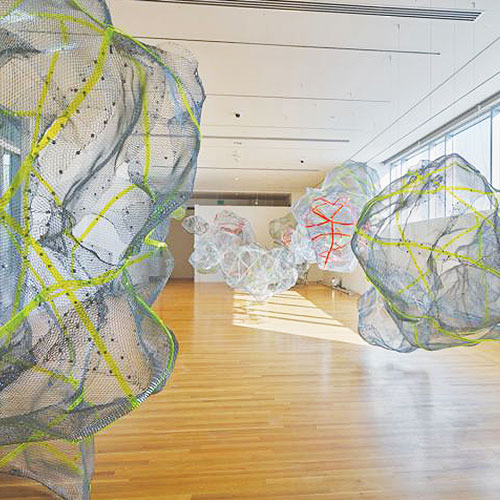
Soo Sunny Park’s “BioLath” seems to sparkle in the Currier Museum of Art’s Putnam Gallery.
The site-specific installation comprises giant boulder-like shapes made from metal lath and colored plexiglass strips, which are suspended from the ceiling and standing on the floor. Light streams through windows and from four artificial light sources and casts shadows against the walls. The sculptures glow.
Your experience may be different depending on the time of day you visit, said Samantha Cataldo, the museum’s assistant curator, during a recent walk-through. The sunlight’s intensity changes as the hours move on, but more importantly, the artificial lights sit on tracks. The shadows move.
“She wanted to mimic the movement and speed of the sunlight, so the walls are always activated by these shadows,” Cataldo said, pointing to the cross-hatching shapes reflected on the walls, some clear, some fuzzy, depending on the proximity of the lath forms.
Park, who lives in the Upper Valley and teaches at Dartmouth, has a resume brimming with installation art, and she’s worked with an assortment of materials: chain-link fencing, steel, paper clips, cotton strings, latex paint, glue, egg cartons, balloons. She loves construction materials, the kinds you never see because they’re hidden by paint or plaster, but the one she’s most fascinated with is light.
“Light is everywhere. You don’t think of it as something that’s present — you focus on the object you see. I’m interested in trying to make light as a form itself a component in the work,” Park said via phone.
The installation is part of the museum’s “Contemporary Connections” series, offering New England artists a platform to exhibit new, experimental work. Cataldo reached out to Park about two years ago to gauge her interest, and Park devised the concept and created the mock-up before constructing the lath forms in her personal studio. She spent the entire week before her Feb. 25 opening on-site, installing and finishing the largest pieces.
Despite the planning and prep work, it’s always interesting to see how it comes together in the end.
“I have a clear visual expectation of how it’s going to work, but really, as the work comes together in space, there’s always a surprise, uncalculated element,” Park said.
Cataldo said “BioLath” has generated a great deal of interest and dialogue. Kids have said the forms look like marshmallows or clouds, and unlike so many paintings and sculptures in the museum, visitors can get close to the work. Their bodies cast shadows on the walls alongside the lath forms and they become part of the installation. They don’t just view it, but are enveloped by it. Or at least, that’s the goal.
“I don’t make representational forms. You can’t say, this is a landscape from Vermont,” Park said. “The end result is not of anything specific. It’s about the experience.”
Come See BioLath
Where: Currier Museum of Art, 150 Ash St., Manchester
When: On view through Aug. 6
Contact: currier.org, 669-6144
Admission: $15 for adults, $13 for seniors, $10 for students, $5 for youth ages 13 to 17, free for anyone younger; during School Vacation Week Monday, April 24, through Friday, April 28, there’s a $5 flat rate admission for anyone 13 and older
Upcoming Events
Storytime in the Gallery: Monday, April 24, at 11:30 a.m. Hear children’s librarian read Roar by Maira Kalman and create a wire figure, all ages welcome
Creative Studio: Collaborative Project with Soo Sunny Park: Wednesday, April 26, from 11 a.m. to 1 p.m., guests will collaborate with the artist on a community project, all ages welcome
Building With Wire: Friday, April 28, from 11 a.m. to 1 p.m., complete
Music: Heavy Sound
FEATURED MUSIC
Heavy Sound
Cello and Drums Duo Lung returns to Shaskeen
Written By Michael Witthaus (music@hippopress.com)
Images: Courtesy Photo
It’ll be an evening of duos and the live debut of a promising local band at Manchester’s Shaskeen Pub on April 21, a Friday night show starring When Particles Collide, a guitar-and-drums pop rock effort that’s also a love story — its members Sasha Alcott and Chris Viner married three years after the band formed.
Opening is Donaher, a Manchester quartet that recently released its first single, “Heather,” a buoyant confection with a Fountains of Wayne and Weezer vibe; it’s part of a forthcoming album produced by Gary Cioffi. The group is led by comic and erstwhile rocker Nick Lavallee and troubadour Tristan Omand.
Featuring on the three-act bill is Lung, the Cincinnati-based team of cellist Kate Wakefield and drummer Daisy Caplan. Electric Light Orchestra long ago validated the cello as a rock and roll instrument, but Lung takes it to an even heavier place on its first album, Bottom of the Barrel. Songs like the edgy title track and the pulsing “Hypochondriac” offer an earthquake’s worth of low end, with a Europop sheen.
In a recent interview, Wakefield recalled that her instrument choice was born from curiosity and necessity.
“I can’t really play guitar and I like rock music,” she said. “I started writing music for cello and voice and started wondering what it would sound like if I used an electric one and plugged it into distortion pedals and a bass amp. ... I think cello is definitely a rockin’ instrument, and of course, there are rock and roll cello groups like Rasputina.”
Lung formed when the two were between projects, Wakefield’s solo work on hold and Caplan done with Babe Rage, an industrial progressive band he formed when the highly successful glam rock group Foxy Shazam went on hiatus. Both were enduring a particularly trying winter when they met to write together.
“I guess that brings good music collaborations,” Caplan said.

They released Bottom of the Barrel last fall; a tour in support of the record included an initial show at the Shaskeen.
“That was mostly because they would have us,” Caplan said with a laugh.
“And because they are awesome,” added Wakefield. “The bands we played with were awesome, too. It’s a cool club.”
Since officially becoming a band one year ago, both have quit their jobs are are now full-time musicians. Their current tour began on St. Patrick’s Day in Louisville, across the river from their hometown, and continued south — the interview happened via phone when they were in Charlotte, North Carolina — then up into the Rust Belt, 44 shows in all, with barely a break.
“I know some people who don’t do work every day and take days off,” Wakefield said, “and our job is way more awesome than theirs.”
Caplan agreed.
“Yeah, it’s pretty fun,” he said. “Every place that we go has a very different feel; you get high off that energy and go forward to the next spot.”
Favorite shows on the current run included a couple in Florida.
“A pizza place in Cape Coral, with a rapper and a bunch of metal bands,” Caplan said. “I really dug a show in Miami that was about this woman’s art; she’s also a musician. All her art was on the walls and she played really beautiful acoustic folk music as well. That was pretty sweet.”
A while back, the two performed at a satanic temple.
“Daisy is good friends with someone who is a mover and a shaker in that community,” Wakefield said. “The show was like a celebration of the changing of the seasons.”
“That was one of the most memorable shows, I think,” Caplan said. “There were a lot of naked people covered in blood.”
Wakefield has resumed work on her solo record, nearly three years in the making and due for summer release.
“Acoustic cello and voices that I loop; lots of live harmonies and layering,” she said. “It informed this project because before I started working on it, I had no idea of how to write for cello and voice. … Playing cello and singing at the same time is more difficult than I had anticipated.”
When Particles Collide, Lung and Donaher
Where: Shaskeen Pub, 909 Elm St., Manchester
When: Friday, April 21, 9 p.m.
Film: The Fate of the Furious
FEATURED FILM
Film Review
The Fate of the Furious (PG-13)
Written By Amy Diaz (adiaz@hippopress.com)
Images: Movie Screenshot
Vin Diesel’s Dom turns against his longtime friends, even his wife, Michelle Rodriguez’s Letty, in The Fate of the Furious, the eighth Fast and Furious movie.
Dom and Letty are on their honeymoon in Cuba when he first meets a woman we later learn is Cipher (Charlize Theron), international hacker terrorist troublemaker whatever I’ve already stopped caring what her deal is. In short, Cipher is the bad guy.
Later, Dom and his team — Letty, Roman (Tyrese Gibson), Tej Parker (Chris “Ludacris” Bridges), Ramsey (Nathalie Emmanuel) — agree to do a job for governmental agent bad-ass Luke Hobbs (Dwayne Johnson). It’s an off-the-books thing to steal an electromagnetic pulse weapon. The team is successful but then Dom double-crosses Hobbs and takes off with the weapon. Hobbs winds up in jail with Deckard (Jason Statham), a criminal from previous movies who has a brother named Owen (Luke Evans), who was also in some of the previous movies.

Hobbs and Deckard, who, hilariously, have cells across from each other (is that how prison works?) basically spend their time trading threats until their breakout is arranged by Mr. Nobody (Kurt Russell) and his associate, whom they mostly call Little Nobody (Scott Eastwood), which I find kind of silly and endearing. Both Nobodies work for another shadowy government organization that brings together Hobbs, Deckard and Dom’s team to find Dom and Cipher. (Side note: By the end of the movie, it appears that Eastwood is auditioning for the “blond lawman” slot left open after the real-world death of actor Paul Walker. Brian, Walker’s character, stays retired in the franchise’s plot along with Jordana Brewster’s Mia, Brian’s wife and Dom’s sister, though the movie does give them a few shoutouts.)
Why is Dom working for a bad guy? Because she has something on him. Something explosive involving a character from a previous movie. Something I never could have guessed. Mostly because I totally forgot about that character’s existence and, when I remembered, first thought the person was a different character, who I actually think might have died a few movies ago.
“I don’t think that’s how fire works.” “I don’t think that’s how gravity works.” “I don’t think a car can do that.” “What did he just say? I don’t think that collection of words actually constitutes a meaningful sentence.” These are statements that apply not only to The Fate of the Furious but to pretty much all of the Fast and Furious movies. Not that it matters. Realistic portrayals of physics and language usage are not the point of these movies. Awesomeness is the point. Unadulterated vroom vroom silly, entertaining awesomeness.
Here, with a few mild spoilers, is what this movie has going for it:
• A car race involving a car that is racing backward and on fire.
• A car chase involving a submarine.
• A car chase involving a wrecking ball.
• A car chase that might make you question the benefits of self-driving cars.
• Dwayne Johnson coaching a little girls’ soccer team that starts its game with a Pacific Islander warrior dance.
• Dwayne Johnson and Jason Statham talking smack to each other.
• Jason Statham conducting a fight scene that weaves together killing a bunch of henchmen, being adorable and what sounds like Chipmunks music.
• Helen Mirren.
Does all of this make sense? No. Again, does it matter? No. Because, is The Fate of the Furious fun? Yes.
At two hours and 16 minutes, this movie should be shorter, I’d say at least 30 minutes shorter. I get that Charlize Theron can do campy villain but she needs to either turn the silliness down a notch or two or turn it way up so she is at Ravenna the evil queen from those Huntsman movies volume from the start. There’s a lot of talk about family and “that’s not Dom” and Cipher’s motives which, gah, I do not care about Cipher’s motives — all of that could easily go. In fact, any conversation that isn’t at least 70 percent characters making fun of each other is probably not a conversation this movie needs.
But plenty of conversations are mostly good-natured insults. And plenty of scenes are more action than talking. These movies know what they are and by this point are pretty good at delivering exactly the fuel-injected entertainment you’re looking for.
Grade: B-
Pop: Driven By Voice
FEATURED POP
Driven by Voice
Ludwig on his Debut Novel, Ginny Moon
Written By Kelly Sennott (ksennott@hippopress.com)
Images: Courtesy Photo
Barrington writer Benjamin Ludwig found the voice of his character Ginny Moon while attending his then-teenage daughter’s Special Olympics games, years ago — though the way he describes it, her voice found him.
“The voice came to me and demanded that I express it, that I write it from that very distinct perspective,” Ludwig said via phone, a couple weeks before the release of his first novel, Ginny Moon, which he celebrates with a May 1 launch party at Water Street Bookstore. “I couldn’t keep her voice quiet! She kept talking, so I kept typing.”
The book, released officially May 2 by Park Row Books, is about a teenage girl with autism named Ginny Moon. For the most part, Ginny’s a typical teenager, playing the flute in the high school band, reading Robert Frost poetry in English class. But she also holds an obsession to reconnect with her abusive and drug-addicted birth mother, Gloria, despite the fact she’s finally found foster parents who care about her. Some of the book’s inspiration stems from Ludwig’s personal and professional experiences.

He and his wife adopted their daughter, who has autism and is now 21, in 2009, at which time they became part of a large Seacoast community of families with kids who have special needs through Special Olympics sporting events. Ludwig also worked in the public school system for years, his most recent job being as a teacher-mentor at Dover Middle School.
“I noticed very early through my own experience teaching … [that] children with special needs use language in a very different way than you and I might use it. We use language to express how we feel, and to think out loud. Very often, children with special needs will only use language to communicate immediate needs. A lot of their world is nonverbal,” he said. “It’s almost like they’re using language as a tool rather than a form of expression.”
But Ginny Moon is very different from anyone he’s ever met — particularly his own daughter, who was happy to hear he’d written about a girl with autism but appalled to learn Ginny was such a rule-breaker.
“Our daughter is on the straight and narrow all the time,” Ludwig said, laughing. “Our own experience with our own daughter was nothing like the experience in the book, thank goodness.” Because his protagonist’s voice came so naturally, Ludwig was able to write the entire manuscript in 2014 with little difficulty.
It was unlike any writing experience he’d ever had, which is saying something, as he’d written 10 other “bad” novels before this one. He’s been a self-described “writing addict” since the fourth grade. Every day, he wakes at 3:30 a.m. to write before his three kids and wife wake.
His book deal happened in 2016 while he was in the midst of earning his Master of Fine Arts at the University of New Hampshire. Ludwig’s position was unique; he’d finished the novel and found an agent before starting the program. His dream is to teach creative writing on the college level.
“For me, the MFA is a teaching degree. Anyone in an MFA program will tell you, you don’t need a college degree to have a book published. Most of our greatest writers do not have MFA degrees,” Ludwig said. “But they won’t let you [teach college creative writing] unless you have a book and also the degree to go with it. The degree shows you’ve studied the craft of writing, so I do think it’s beneficial.”
Until then, he’s busy promoting Ginny Moon. After the book launch, he steps on a plane for a cross-country book tour. He hopes readers have a good time reading Ginny’s story, but he also hopes the book raises awareness about the need for adoptive parents in the United States.
“My wife and I will definitely adopt again at some point,” Ludwig said. “There are kids out there who need homes. And a lot of them are teenagers. It’s something good to think about and reflect on, and maybe even consider.”
Meet Benjamin Ludwig
Where: Water Street Bookstore, 125 Water St., Exeter, 778-9731, waterstreetbooks.com
When: Monday, May 1, at 7 p.m.
MORE HEADLINES
Pretty Tasty
Pretty Tasty
Cookbook Features Beautiful Dishes with Herbs and Flowers
Written By Angie Sykeny (asykeny@hippopress.com)
Images: Stock Photo
Chef, gardener and cooking instructor Liz Barbour of The Creative Feast has a philosophy when it comes to food: It should look as good as it tastes. Now, she’s teaching others how to prepare nutritious and visually stunning dishes with her new cookbook Beautifully Delicious.
Beautifully Delicious is Barbour’s first published cookbook and is inspired by her edible garden in Hollis, a garden in which she arranges fruit and vegetable plants, herbs and edible flowers among ornamental plants and flowers, the concept being that growing food doesn’t have to mean sacrificing aesthetic.
“The title perfectly describes what the book offers; all of the recipes are focused on food that is beautiful to look at and that tastes delicious” Barbour said. “Because they’re so beautiful, a lot of the recipes look complicated, but the fact is, they’re very simple to make.”

The book features more than 60 recipes highlighting herbs and edible flowers that can be easily grown at home or found at a local grocery store. Many of the herbs are ones commonly used in the kitchen, and the flowers, though still up-and-coming as a food ingredient, are well-known varieties such as pansies, marigolds, roses and tulips,
“The idea is that the ingredients are familiar, and that goes for the edible flowers, too,” Barbour said. “It’s just that people haven’t been as free with using them for cooking, so this book gives you permission to use them.”
Beautifully Delicious includes recipes for things like flower and herb summer rolls, flower and herb salads, zucchini noodles with herb pesto, rack of lamb with mint sauce and salmon filet with herb Dijon. There are also recipes for drinks, like lavender-infused gin, and for pastries and desserts, like flower crepes and marigold cake with buttercream frosting.
Most recipes have variations, such as a potato-based garden herb soup that can be turned into a spiced-up seafood chowder with shrimp, scallops, haddock and saffron, or into a winter chicken herb soup with corn and rice. Additionally, there are ideas for how to transform leftovers, like blending a salad into a healthy smoothie.
“Sometimes you have leftovers and wonder how to use them up, so I wanted to make sure there were options for people to change up the recipes the way they like,” Barbour said. “You can add a variety of other ingredients to a recipe and give it a whole other flavor profile.”
Each recipe includes detailed step-by-step instructions and photos to aid the process. Between recipes, the book also features lessons on herbs and how to use them, proper knife techniques and cooking methods for things like how to cut and cook an onion.
Beautifully Delicious can be pre-ordered on The Creative Feast website or directly from Barbour during any of her upcoming library programs. It is set to ship in early May.
On Tuesday, April 25, Barbour and the book’s photographer Celeste Guidice will be at the Hollis Social Library to talk about the writing, photographing and self-publishing process of the book, and they may bring some recipe samples for people to taste. Those who pre-order the book at the presentation will receive copies signed by Barbour once it ships.
After the book is officially released, Barbour will sell and sign copies at The Cozy Tea Cart in Brookline on Saturday, May 13, and at her annual edible garden tour happening at the end of June, where people can see many of the herbs and edible flowers featured in the book. More Beautifully Delicious presentations and signings are to be announced.
Beautifully Delicious
The cookbook is available now for pre-order and set to ship in early May. To learn more about it, view sample pages and pre-order a signed copy, visit thecreativefeast.com/cookbook. The book costs $35; shipping is free for orders of four or more copies.
Liz Barbour Cookbook Events
Hollis Social Library, 2 Monument Square, Hollis, on Tuesday, April 25, from 6:30 to 8 p.m. Admission is free, but registration is required. Visit hollislibrary.org.
The Cozy Tea Cart,104 Route 13, Brookline, on Saturday, May 13, from 10 a.m. to 2 p.m. Admission is free. Visit thecozyteacart.com.
Edible garden tour at The Creative Feast, 5 Broad St., Hollis, in June, date TBA, Admission is free. Call 321-5011 or visit thecreativefeast.com.
Weekly Music Review
Weekly Review
Kelley Ryan & More
Written By Eric Saeger (news@hippopress.com)
Images: Album Artwork
Kelley Ryan, Telescope (Manatee Records)

This California/Ireland-based indiefolkie has lazed under the mainstream radar for 20 years, along the way contributing soundtrack moments to such TV shows as Felicity, Roswell and — since one takes it where one can get it — the soap Another World. This is her eighth album if you count her (also solo) oeuvre under the name astroPuppees, a project that could get a little grungy on the guitar side, but since then she’s gone onto a more housewifemanna approach, including here at this batch of wispy, caramel-nougat-filled Weepies-like songwriting exercises that are quite good at times, “Pulling for Romeo” in particular. Principally it’s introspective, lazing-by-the pond substances punctuated by stress-free additives like toy-piano, mouth-pops, things of that stripe, whether her guitar is plugged or unplugged. Most everything is kid-safe and major-key-centric, the one notable exception being “The Darkest stars,” a torchy, pining trifle Ryan’s Shawn Colvin-like voice curls itself around to good effect.
Grade: A-
Cinema Cinema, Man Bites Dog (Labelship Records)

It’s so weird, I was 100-percent sure I’d covered one of this avant-punk duo’s albums before, but after a lot of digging it appears I haven’t. Brooklyn-based cousins Ev Gold (guitar) and Paul Claro (drums) launched this project in 2008, founded on a love for antique SST Records releases and a Greg Ginn connection that eventually led to a 50-date tour opening for Black Flag in 2014. The great thing about this sort of setup — one guy stomping around wailing on an ax and providing plenty of visual cues for the drummer to go by — is the rootsy, organic output, in this instance an ability to change tempo at one glance, but these guys’ past stubborn fourth-grader fascination with that stuff has given way to more rhythmic cohesion. Their penchant for calamitous, theatrical pseudo-industrial noise is still intact (“Bomb Plot”), while filler tunes like “Run Until You’re Out” read like a mixture of Redd Kross and Soundgarden. Tortured, mercurial, perfect stuff.
Grade: A
Sails Pitch
Sails Pitch
Great Northeast Boat Show Moves to Bedford
Written By Matt Ingersol (listings@hippopress.com)
Images: Courtesy Photo
Summer is fleeting in New Hampshire, but the Great Northeast Boat Show can help get you ready to hit the water as soon as the weather warms up.
The 8th annual show, which will feature more than 25 local dealers and 175 boats, will be held over three days at the New Hampshire Sportsplex in Bedford on Friday, April 21, from noon to 8 p.m., Saturday, April 22, from 10 a.m. to 8 p.m., and Sunday, April 23, from 10 a.m. to 4 p.m.
The event is the largest indoor boat show in the Northeast north of Boston and features everything from small fishing boats to larger pontoon boats, speedboats, jet skis, yachts, stand-up paddleboards and more.
Show co-organizer Suzette Anthony said about 90 percent of the exhibitors who will appear at this year’s show are from New Hampshire, with a few additional dealers from Maine and Massachusetts.
“We originally came up with the idea to have a boat show [in New Hampshire] because my husband and I have a home up on Lake Winnipesaukee,” she said. “We knew that there was a boat show in Boston, but [prior to this show], there was not a big quality boat show in New Hampshire. People living up here had to travel all the way down to Boston for it … and a lot of second homeowners are on Lake Winnipesaukee or on another lake, so that’s who we wanted to target for the show.”
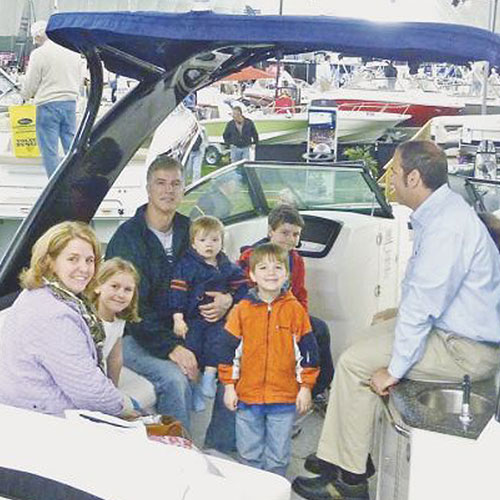
Even if you’re not looking to buy a boat, Anthony said the show is a great event for families, and especially for fishing or boat enthusiasts looking for an accessory to upgrade or to talk with professionals in the business. Among some of the local vendors will include Bass Pro Shops in Hooksett, the Contoocook River Canoe Company in Concord, daSilva Motorsports in Hampstead, Granite State Dock & Marine in Derry and several others.
She added that several of the dealers will be offering specials during the show only.
“There are also going to be some insurance companies there as exhibitors, so you’ll actually be able to walk from one to the next and talk to a professional about insurance and financing information,” she said.
Despite the show taking place during the spring season, it is actually much later than some of the larger shows south of New Hampshire.
“Oftentimes boat shows in Boston and in New York City are in January or February,” Anthony said. “However, having ours [later] is an advantage, because an interested buyer can talk to a dealer and potentially be out on the water … after ice-out.”
8th Annual Great Northeast Boat Show
When: Friday, April 21, noon to 8p.m., Saturday, April 22, 10 a.m. to 8 p.m., and Sunday, April 23, 10 a.m. to 4 p.m.
Where: New Hampshire Sportsplex, 68 Technology Drive, Bedford
Cost: $10 general admission; free for kids under 12 with accompanying adults
Visit: greatnortheastboatshow.com
More City Chicks?
More City Chicks?
Petition Would Loosen Restrictions for Backyard Chickens
Written By Ryan Lessard (news@hippopress.com)
Images: Courtesy Photo
Kaitlyn McCarthy, a 30-year-old nursing assistant, has started a petition on change.org called “Reduce the Backyard Chicken restrictions in Manchester NH.” The Queen City resident hopes she can collect enough signatures to demonstrate strong support for a change to the city zoning ordinance that would allow more properties to raise chicken hens for personal use.
Right now, residents who own their own property can have up to six backyard hens of any breed if they have at least half an acre of land and the chickens are kept 20 feet from the property line, according to Dave Albin, code enforcement supervisor for the city.
McCarthy wants to change the land size requirement to one tenth of an acre or 5,000 square feet to allow smaller properties to adopt chickens.
“Most lots in the city are 5,000 square feet,” McCarthy said.
She also wants to change the setback to five feet.
“[The current rule] is a little silly. You’d have to have chickens in the middle of your yard,” McCarthy said.
While the petition doesn’t expressly say it, McCarthy would also like to do away with the land ownership requirement, which she thinks is “classist.”
About four years ago, McCarthy had her own chickens at her apartment property after getting permission from her landlord. Her neighbors enjoyed them, McCarthy said. But after the landlord was told by a code inspector that they had to go, McCarthy was forced to hand them over to someone else.
She worked closely with a local group of residents who organized to change the city rules in 2014. Prior to that, chickens were governed by the same rules as other livestock animals. Under that regime, one would need to have 1 acre for the first animal and 1/4 acre for each additional animal.
The new rules allowed a lot more residents to get chickens of their own, but McCarthy still can’t have any at her apartment.
At press time, the petition had obtained 175 signatures, most of those in the span of just a couple days after McCarthy shared the link on more social media groups.
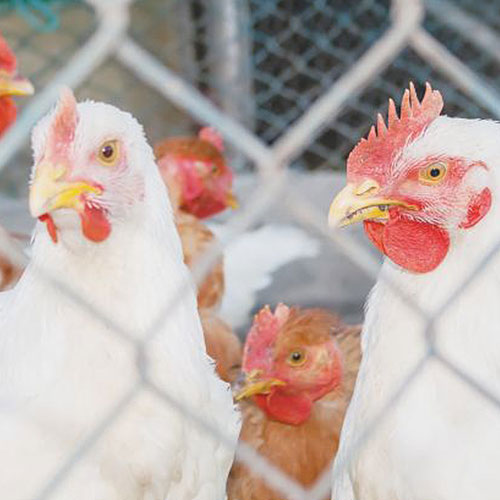
After she’s obtained at least a few hundred more signatures, McCarthy hopes to start the conversation with aldermen about how to change the ordinance.
Albin said there’s no way to know how many chickens there are in the city since chicken owners are not required to have a permit. But he has noted an uptick in chicken-related complaints, which might be an indication of their growing prevalence.
Albin said he’s worked in code enforcement for Manchester since 2008 and in the first five or six years he received about two or three chicken-related complaints each year. Last year, he estimates he responded to about 10 or 12 chicken-related complaints.
“This year I’ve done six complaints for chickens,” Albin said.
The vast majority of his complaints are related to roosters, which are not allowed, and escaped and free-roaming chickens. But, once he responds to these cases, Albin almost always finds that the owners don’t have the required full acre of land. So Albin has to inform them the chickens aren’t allowed there.
“Chickens are chickens. They make noise. Whether you like the noise or not, they make noise,” Albin said.
And while the animals themselves are generally odorless, their feces could become problematic if it’s not managed properly, both due to its odor and potential diseases.
According to the city ordinance, there are two things people can do with the animal waste; either comp