

FEATURED HEADLINES
Food: Take On The Tacos
FEATURED FOOD
Take On The Tacos
Hippo de Mayo Returns to Downtown Manchester
Written By Angie Sykeny (asykeny@hippopress.com)
Images: Courtesy Photo
Thousands of taco-lovers will head to downtown Manchester on Thursday, May 4, for the world’s largest taco tour, the Hippo de Mayo Taco Challenge, featuring nearly 50 downtown restaurants selling unique $2 tacos they’ve created just for the event.
“We were looking for an event that would bring people out into downtown and into the streets,” said Hippo Publisher Jody Reese, who created the taco tour with his staff in 2009.
“The time of year fit to do something with tacos. We looked around, and there was really nowhere else where they were doing organized taco tours, so we thought it would be a fun idea.”
During the five-hour event, people can walk to participating restaurants, trying tacos and voting on their favorites to win the People’s Choice Award. Restaurants will also be vying for a Judges’ Choice award, and both winners will receive $1,000 to benefit the charities of their choice.
These year’s participants include cafes and delis, pubs and diners, farm-to-table and vegan eateries, candy and ice cream shops, steakhouses and seafood restaurants and a variety of ethnic restaurants including Greek, Italian, Mexican, Brazilian, Indian, Hungarian, Vietnamese, Japanese and Chinese.

“If you think about it, a taco is just a piece of bread with stuff in it,” Reese said. “That’s the nice part about it. It’s very versatile. Every culture has a taco.”
Taco tourists can look forward to several first-time participating restaurants this year, including recently opened restaurants like vegan juicery and cafe Milk & Honey and apothecary-inspired eatery Restoration Cafe, as well as some well-established restaurants like Piccola Italia Ristorante, which is in its 16th year of business.
“Every year, I thought, ‘But we don’t sell tacos here.’ ... I didn’t see the fun part about it,” said John Paolini, owner of Piccola.
His chef, Heather Pelletier, who joined the Piccola team last September, prompted his change of heart.
“I’ve gone to Taco Tour before, and I always thought of it as a fun kind of chaos,” Pelletier said, “so it was exciting to hear that [Paolini] hadn’t done it before. I thought it’d be nice for our clientele to see us do something new.”
“So this year I said, ‘Let’s do it. Let’s have some fun,’” Paolini said.
Piccola will feature a chicken Parmesan taco — a breaded fried chicken cutlet with sauce and shredded cheese inside a hard taco shell, and a Caesar salad mix sprinkled on top. The idea was inspired by one of Piccola’s kitchen workers who often makes himself a chicken Parmesan sub with a bit of Caesar on top. Pelletier said it’s the perfect taco to represent the restaurant.
“We sell a lot of chicken Parm. It’s a staple in the Italian world.” she said. “When you go out [for Italian food], that’s one of the things you think of.”
Those who didn’t try the Judges’ Choice winning taco last year will have a chance to this year as Mediterranean restaurant Campo Enoteca brings back its eggplant polpetti taco, made with eggplant, artichoke white bean purée and pico de gallo pepper relish.
Peter Macone, operational manager for Campo Enoteca and farm-to-table restaurant Republic, also a taco tour participant, said the tacos allow the restaurants to highlight the styles of cuisine featured on their menus; for Campo, the eggplant is a common special and the relish is used as a garnish on its artichoke small bites. Republic’s falafel taco is inspired by the restaurant’s vegan-friendly menu, which includes a falafel plate, and has a homemade tahini dressing and red cabbage slaw that can be found with Republic’s chickpea ragu dish.
“We may not have tacos on the menu regularly, but everything in our [Taco Challenge] taco is a piece of one of our dishes and can be found somewhere on the menu,” Macone said. “We take different flavors from our menu and say, ‘These will go great together.’”
With so many tacos being featured that day, it can be hard for restaurants to make their taco stand out.
“For me, the flavors need to blend, and it’s got to have a little crunch to it,” Reese said of what makes a memorable taco for him. “[Restaurants] should mix different textures and get a little freshness in there with whatever that may be.”
To make the most of your taco tour experience, Reese said, do some research beforehand and go in with a plan; map out eight to 10 places with tacos you want to try and tackle those places. Also, don’t be afraid to branch out into the outskirts of the taco tour map or you could be missing out on some fabulous tacos.
“People tend to congregate in the Lowell Street-Elm Street area, which is great, but I strongly suggest hitting the outer areas first,” Reese said. “Once you hit those, it’s easy to come in and hit Elm Street, but you’re getting some geographic diversity in there.”
For more information visit: www.hippodemayo.com/
News: Disunified Government
FEATURED NEWS
Disunified Government
A Look At the NH Freedom Caucus
Written By Ryan Lessard (news@hippopress.com)
Images: Stock Photo
When the House failed to pass a budget for the first time in decades, Speaker Shawn Jasper, a moderate Republican, criticized the 30 to 60 fellow Republicans who blocked the legislation, which didn’t raise taxes but did increase spending. That opposition, which calls itself the New Hampshire House Freedom Caucus, was happy to take credit.
Origins
J.R. Hoell, a fourth-term Republican state rep from Dunbarton, says he co-founded the caucus with the help of a former House member from the Seacoast who wishes to remain anonymous.
“On March 24, the URL was registered with a phone call between myself and one other person and within a week we had decided the budget … was significantly higher than we wanted to see,” Hoell said referring to the website nhhfc.org. “The spending was up almost $300 million on the state portion of the budget. And we started having meetings with various members who were opposed to [House Bill 1].”
According to its official description, the caucus is a grassroots organization that consists of legislators and private citizens who believe in “personal liberty” and “traditional conservative ‘Yankee’ values.”

Hoell said there is no official, published list of caucus members but there is an email chain that includes the interested members. Even in their first major victory, the defeat of the budget, they didn’t act as a cohesive unit. Sixty-six Republicans voted against the budget and 32 voted against the budget trailer bill, HB2.
Hoell estimates the larger conservative faction, as he calls it, numbers around 85. For an idea of which members are included in that, he suggests looking at the roll call to see the Republican “nay” votes opposing the dairy farm relief bill SB10.
Hoell says nearly all parts of the state are represented in the caucus.
“It’s across the state,” Hoell said.
Hoell had some help from former House Speaker Bill O’Brien when Hoell asked him to invite members to a meeting where they spent two hours discussing budget numbers and arriving at a clear goal.
Besides the website, the group also has Twitter and Facebook accounts.
The formation of the New Hampshire House Freedom Caucus was inspired by the similarly named group in Congress, which prevented Speaker Paul Ryan’s plan to repeal and replace the Affordable Care Act.
“The House Freedom Caucus was kind of a branch off of what we saw in Washington, D.C., when a small group of conservatives got together and stopped effectively Obamacare 2.0 and said, ‘We want a complete repeal.’ Just nipping around the edges wasn’t good enough,” Hoell said. “We did the same thing. In this case, it was regarding a very bloated New Hampshire state budget that was proposed by the House.”
What it Wants
The caucus was founded primarily to push back on a budget its members thought was too bloated.
“Our party platform was very clear on state spending not rising faster than the rate of inflation plus population growth. … So we drew the line in the sand based on historic rates of inflation relative to growth of the state spending,” Hoell said.
He said spending in this budget grew by 10.5 percent over the biennium. Judging by the most recent consumer price index data, Hoell and his fellow caucus members decided spending growth should not exceed 3 percent, or 1.5 percent annually.
Partly, this is due to the fear that sending millions to local communities will create a new normal that is based on stronger revenues from a good economy and communities will be forced to raise tax rates or make cuts when the economy slows down.
Hoell is optimistic that the Senate will produce a budget more to the liking of the caucus and expects a longer period of deliberation than the typical week where House and Senate merge budgets known as the committee of conference.
After this budget process is concluded, Hoell said, it’s possible the group might continue to serve a purpose.
“There is clearly an interest in having a group in Concord that supports the individual rights of the taxpayers, that protects their personal liberties and while there are a number of outside groups, there is no internal caucus that focuses just on that. And maybe that’s the need that this group fills long-term,” Hoell said.
On April 20, it was announced that the caucus had created a PAC that would raise money to help the campaigns of current and future members.
Historical Phenomenon
Political analyst Dean Spiliotes said it’s not uncommon to see internecine fractures within a party and for wings of a party to stall legislation desired by party leadership even in cases where the party has control of the legislature and the executive.
“To be fair, it’s not just the GOP. It’s really a larger phenomenon involving unified government in general,” Spiliotes said.
He points to cases at the federal level where unified government was thwarted by members of the controlling party that tended to be on the wings of the ideological spectrum, such as the first couple years of the Eisenhower administration, the Carter administration and the Clinton administration.
Spiliotes said it tends to be easier for parties to coalesce when they’re in the opposition.
“When you finally have unified government, there’s an assumption that you can finally move the party’s agenda forward but what you end up seeing is these fissures that maybe have been sort of temporarily downplayed or less visible start to become more obvious,” Spiliotes said.
Arts: Melancholic State
FEATURED ARTS
Melancholic State
Theatre KAPOW Takes on Melancholy Play
Written By Kelly Sennott (ksennott@hippopress.com)
Images: Courtesy Photo
What does melancholy actually mean? Sad? Mournful? Pensive? All three?
It’s a question the cast of Melancholy Play: A Chamber Musical has been mulling over for weeks while preparing for theatre Kapow’s production at the Derry Opera House April 28 through May 6.
“It’s not depression. It’s melancholy. It’s a different state,” said actress Candace Gatzoulis during a recent rehearsal. “This idea of melancholy has been really, really hard for me to put my finger on. How can you explore sadness without deep sadness?”
The topic’s at the center of Sarah Ruhl’s piece, first presented in 2002 at the Piven Theatre in Illinois as a straight play until composer Todd Almond set it to music in 2012. It follows a melodramatic bank teller, Tilly, whose melancholy causes every stranger she meets to fall in love with her — until one day, when she becomes inexplicably happy, wreaking havoc on her friends’ lives. Her hairdresser, Francis, delves into such a deep state of melancholy she turns into an almond.
“I think the play deals with the concept of happiness in an interesting way. I think that word always has a positive connotation, but I think we’ve all been in a situation where we’ve been a little resentful of someone else’s happiness, and I think this play articulates that really well,” said Jimmy Stewart, who plays Frank.

Yes, the play contains elements of absurdity. At one point, there’s a physical fight over a vial of Tilly’s tears. But at its core is profound truthfulness, which is what drew actress Emily Karel to the show.
“Sarah Ruhl is one of my favorite contemporary playwrights. I wanted to audition, even though I hadn’t been in a musical in a really long time,” Karel said. “She has a unique way of expressing a feeling or a state of being with her language, and this musical, I think more than a traditional musical, feels very intimate. There’s a rawness, a beauty and vulnerability that I think audiences will appreciate.”
The text didn’t change at all while transitioning from a play to a musical. The only difference is that now, some of the lines — particularly the emotionally charged ones — are sung instead of spoken. There’s a lot of depth in plot and character, which can be difficult to translate while singing.
“To be in an emotionally conflicted state … and then sing is quite a challenge to me because I haven’t done it in such a long time,” said Wayne Asbury, who plays Lorenzo. “Usually when you’re in that state of sadness [on stage], you’re able to sink into yourself. And singing requires you to do the opposite, to really open up and share that with the audience.”
Theatre Kapow, whose Season 9 theme is “Hear, Here,” typically tackles straight plays, no music. But the board liked Melancholy Play and felt that to do it justice, they’d need to go with the chamber musical, which isn’t performed often because of its difficulty; you need to find people who can sing, and hold their own in five-part harmonies.
They found Stewart (Frank), Asbury (Lorenzo), Sheree Owens (Joan), Gatzoulis (Tilly) and Karel (Frances). Musical director is Blake Leister, and performing alongside the group is the New Hampshire Philharmonic string quartet.
Melancholy Play was never on Broadway or off-Broadway, and so there was little to go on beforehand. All the production elements are new theatre Kapow interpretations. Theatre Kapow director and cofounder Matt Cahoon said this version is stripped down, taking place on the Derry Opera House floor within a 17-foot-by-17-foot square that, over the course of the show, transforms into a therapist’s office, a tailor shop, an apartment. He thinks audiences will relate to the characters and the messages about depression and melancholy.
“A lot of this show is about kind of recognizing when people are in a bad way or a tough place, and doing what [you can] do to support them and take care of them,” Cahoon said.
Music: A Healing Art
FEATURED MUSIC
A Healing Art
Hip-Hop Show Celebrates CD Release
Written By Michael Witthaus (music@hippopress.com)
Images: Stock Photo
For Cody Pope, art inspires religious fervor. His independent company is called Vatican Life, and he believes the muse is a deity.
“Whether it’s photography, music, painting or whatever you do,” he said in a recent Skype interview. “If that’s what you want your life to represent, you should hold it in the highest regard, the same way that people do their religion.”
The Nashua native began playing punk and metal music during his teenage years. In 2010, he moved from hard rock to hip-hop, inspired by hometown acts like Granite State.
“I was blown away,” he said. “These were such talented artists, doing something so different from what we heard on the radio.”
For his new CD, Empathy & Emptiness For Those in Empty Nests, Pope enlisted Granite State’s Bugout, along with New Hampshire rappers Ape the Grim, Tim Nihan and Mike Wing. At an all-ages release show on April 29 at The White Birch in Hudson, Pope will perform the entire record with these special guests, each of whom do their own sets.
One of the reasons Pope left rock was the volatile chemistry of band life.
“Trying to get five people’s goals to align, things would always fall apart for one reason or another,” he said.

Making the new disc forced him to muster a new level of trust.
“I don’t typically have features on my songs, so to have guys that I looked up to featured on these records … brings it full circle, and that’s what I want the show to represent,” he said.
Empathy & Emptiness represents Pope’s transition from defiantly independent to more accepting. “The Hunger” describes the challenge of succeeding in an often unforgiving business — “if money is the root of all evil, I’m a saint,” he raps — while “The Fall” is a confession of sins and hope for redemption.
“That’s when I felt the darkest, and I was struggling to see a purpose in life,” Pope said. “Without Vatican Life and hip-hop I could have easily not been here right now … that song is about being OK with the fact that I did things I’m not proud of [and learning] how to grow from them.”
The vitriolic “Last of a Dying Breed” is a standout track. Though it sounds pointed, Pope had no particular target in mind.
“It reflects my frustration with things that continue to happen year after year with so many incredible artists; they are not willing to make the extra sacrifice to get their art where it could be,” he said. “As a fan, it frustrates me. … People miss out on things that could change the world potentially.”
The struggle to overcome is a recurring theme on the record. Pope reflected on this in a recent Facebook post.
“This record means so much to me, and yet life has been such a wild hand of cards lately that it didn’t hit me til we were in the moment,” he wrote. “Now I can finally share with the world all of these stories of growth and strength, in a time where I’ve needed it more than ever without even realizing it.”
In addition to performing, Pope ran the Misery Loves Company showcase at Carlo Rose Cigar Bar in Pelham for its two-and-a-half-year run; he still promotes an occasional show there. He’s a regular at Shaskeen Pub’s Sunday Rap Night, along with Seacoast and Maine events.
“The hip-hop scene just continues to grow, and I could not be more grateful to be part of it,” he said. “There is so much versatility in the music that you can acquire from hip-hop artists, so you never stop learning something new every day.”
Some proceeds from the upcoming show will benefit the sober living facility Homestead Inn. The all ages aspect is also important to Pope.
“There are a lot of kids in junior high school that don’t have the opportunity to experience this music the way some of us older guys get to,” he said. “It was really important for me to make something that was inclusive. … This is an event that is cool for anybody who cares about music, live art and community.”
Film: Unforgettable
FEATURED FILM
Film Review
Unforgettable (R)
Written By Amy Diaz (adiaz@hippopress.com)
Images: Movie Screenshot
Katherine Heigl turns her “tightly wound blonde lady” all the way up to full volume in Unforgettable, a silly but watchable thriller.
Julia Banks (Rosario Dawson) is your down-to-earth everygal. Having moved past a violent relationship, she is now happily engaged to swell guy David (Geoff Stults), who runs his own small brewery in a peaceful southern California town. Some kind of editor, Julia can take her job on the road and moves south from San Francisco to live with David and, part time, David’s daughter, Lily (Isabella Kai Rice).

Welcome to the neighborhood, says Tessa (Heigl), David’s ex-wife and Lily’s mom, with her words. But her eyes say “get ready for the craziest crazy that ever crazied.” Even before Tessa steals Julia’s phone to create mischief, we know Tessa has decided to go all in with belittling and gaslighting Julia.
Why, you ask? In part it’s because Tessa has an obsession with perfection and not failing (her brief affair was the catalyst for David’s ending their already unhappy marriage), as evidenced by her conversations with her equally controlling mother (Cheryl Ladd). In part, it’s because she is straight up nuts like only the villain of one of these movies can be. When she’s not skulking around David’s house to steal Julia’s engagement ring and generally sow discord, she creating fake Facebook accounts to get “Julia” back in touch with her abusive ex-boyfriend.
The problem with Tessa’s ever-intensifying campaign of messing with Julia is that pretty early on most people would probably say “thanks for the proposal but I’m out” to David. If not before, the point where Tessa stages an accident to make it look like Julia pushed her down the stairs is the point where I would have bags packed and a lawyer on retainer. Julia also doesn’t tell David about her violent ex for much longer than makes sense for her character and her current situation.
But complaining that a catfight thriller doesn’t make real-world sense is a bit like complaining that the cars in The Fast and the Furious movies are unusually accident-prone.
Rosario Dawson is good at playing the audience surrogate, constantly trying to decide if she’s being overly sensitive or if the crazy lady is really as crazy as she suspects. She brings a grounded-in-reality quality and sense of humor to her character.
Even better is Heigl, who seems to have found a good way to reuse that one rom-com character that she seemed to play in multiple movies during the aughts. Tessa is a ridiculous character but she fits with the tone of the movie and she makes all the silly parts of the story work.
Unforgettable is not a good movie, not smart the way that Get Out, which had some similar elements, is, but it is a fun entry into the lady-villain thriller territory.
Grade: C+
Pop: Garden Variety Cover Stories *
FEATURED POP - * COVER STORY *
Rose Rules
What to Know Before Growing Your Own
Written By Kelly Sennott (ksennott@hippopress.com)
Images: Courtesy Photo
Roses are red. Or pink. Or yellow. Or any color, really, now that we’ve stepped into the 21st century.
There’s a lot to learn before growing your own rose garden, but there’s no better time to do it, with hundreds of varieties to choose from based on what you’re looking for in terms of aesthetic, maintenance and location. For the most part, they require a lot less work than rose gardens of yesteryear.
Why Roses?
Roses are iconic. They’re what you get your significant other on Valentine’s Day, your mom on Mother’s Day, your grandmother on her birthday.
“I think many people associate with the romanticism of roses, and that’s part of it for some gardeners,” said Jeremy DeLisle, education center program coordinator with the UNH Cooperative Extension.
Eric Jacobs of Jacques Flower Shop and Garden Center in Manchester has known people to plant rose bushes in memory of loved ones, or just because they’re the same kinds of shrubs they saw in parents’ or grandparents’ gardens. They’re pretty all year long.
“Most people like to grow roses because of the fragrance, colors and the fact that they’re long-lasting blooms,” said Debbie Elliott, who manages annuals, perennials and houseplants at Delahunty Nurseries & Florist. “Once they start flowering, which is usually around June, they last right through to the frost.”
Varieties
Before you make the purchase, it’s important to assess what you’re looking for and where you’re looking to plant. How much salt can your roses withstand, and what temperatures?

Hybrid tea roses are the most traditional roses, and are probably what you would have seen in older gardens. They’re upright shrubs that grow four to five feet tall, with flowers supported by long, upright stems. Generally, these rose bushes contain fewer flowers than other varieties, but each flower is big. These are the kinds of roses bouquets are cut from, and they require a great deal of care.
Climbing roses are high-maintenance, too, crawling up trellises and the sides of buildings. Rosa rugosas, beach roses, are heartier plants that are less needy and more salt-tolerant, perfect for homes near salty roads or ocean air. Polyantha roses are short shrubs featuring small, clustered flowers.
But the most common roses sold in New Hampshire are Knock Outs, whose bushes are hearty enough for New England weather and are popping with flowers.
“The reason people like Knock Out roses is because of their disease-resistance and the fact they’re fairly prolific bloomers,” DeLisle said. “They’re really grown as a means to avoid having to use a lot of fungicides for some of the foliage diseases roses get.”
Pick Your Plot
A rookie mistake is choosing the wrong location. The ideal spot gets at least six to eight hours of uninterrupted sunlight, is protected from salty roads or strong winds and is perched on a plot of soil with good drainage.
Good sunlight ensures rain and dew evaporate quickly from petals, discouraging fungal diseases, and proper drainage will prevent “wet feet,” which roses won’t tolerate, said Nettie Rynearson, recently retired owner of the former Uncanoonuc Mt. Perennials in Goffstown. She also advised planting roses far from plants they’d be competing against for root space.
Soil with organic matter (compost, mulch) is best, which will help plants conserve moisture without becoming soggy. The ideal pH level is between 6 and 7; you can get yours tested through UNH Cooperative Extension.
Maintenance
If you’re going to grow roses, the time to shop around and get planting is now through mid-May. Newer varieties are easier to care for than the older ones, but roses in general still require more work than other flowers. It’s going to be an active experience.
“A true gardener wants to be out in the garden with the plants — if you don’t want to do that, I wouldn’t suggest getting a rose bush,” Jacobs said. “You should tend to it at least once a week if not more often.”
Maintenance also involves monthly fertilizing (using soil test results or a special rose fertilizer), mulching, watering, pest control (Japanese beetles, rose beetles and aphids) and pruning. (Though, different kinds of rose plants require different kinds of pruning, so it’s best to check with an expert before making any major snips; in general, you should prune more in the spring, when plants are less susceptible to injuries, said DeLisle.)
Many need to be winterized — like climbing roses, which should be taken off trellises, placed on the ground and covered with shredded leaves or evergreens.
“The rose family is such a big family,” DeLisle said. “For someone who’s just starting out, it’s a good idea to look at rose catalogs or at online resources. Spend time studying those to figure out what type of rose will work best for your situation.”
Take It Inside
How To Create An Indoor Container Garden
Written By Angie Sykeny (asykeny@hippopress.com)
Images: Courtesy Photo
If outdoor gardening isn’t an option for you, or if you just want to add some life and color to your home, consider starting an indoor container garden — a freestanding miniature garden with multiple types of plants potted in a single container.
“If you live in New England, it’s a must,” said Kim Thibault from House by the Side of the Road garden center in Wilton. “Business picks up immensely in the winter because it’s like a little getaway. You have a piece of green inside even when it’s white outside.”
What’s Your Type?
Charlie Cole of Cole Gardens in Concord said there are two types of indoor gardens: long-term and short-term. A long-term garden is one that you plan on making a permanent fixture in your home. It features plants that are hardy in an indoor environment and can survive through the winter, which can include flowering plants with a long bloom period like begonias, kalanchoes, African violets, orchids and peace lilies.
“Think of long-term plants like you would a piece of furniture or a painting on the wall,” Cole said. “Since they will be there long-term, you should focus on getting ones that are the right size and right color, and know where you want to put them.”
A short term garden has seasonal plants that provide instant color and fragrance but do not last through the year, such as daffodils, tulips and azaleas. Once the flowers have waned, you can reuse your container garden and switch those plants out for new ones.
“You aren’t stuck with it all year long,” Cole said. “You can do a daffodil in the spring, then, once spring is over, you can do something that requires less sunlight, like a peace lily.”
Get it Contained
To start an indoor container garden, you’ll first need to choose a container. It could be a glass jar, a piece of pottery, a decorative plastic pot, an antique heirloom or any other structure that fits your home decor and is appropriate for the size you want the garden to be.
According to Cole, there are three main styles of container gardens: fillers, which include regular sized plants; thrillers, which include larger, more showy plants; and spillers, which include plants that cascade over the edge of the container.
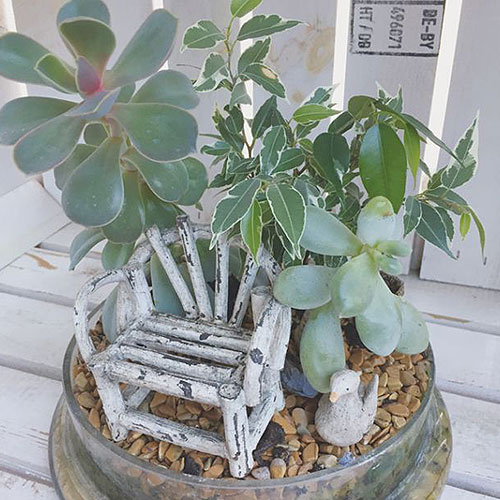
You can also put your plants in separate pots and line them up in a container to look like they are all potted together. That way, if one plant dies, or if you want to replace or reposition a plant, you can easily take it out without having to uproot and replant the whole container.
When choosing a container, you should also consider any decorative accessories that you want to add to your garden.
“You could put a unique rock or a shell on top of the soil,” Thibault said. “Or, if you plant the plants loosely enough, you can put [decorative pieces] in the soil and have them stick out.”
Thibault said terrariums in which you can construct your own miniature landscape have been growing in popularity, and so have fairy gardens, which are designed with tiny, detailed accessories to create a small-scale whimsical world.
“You can add little gravel walkways and little fairy ponds,” she said. “I know people who even make their own fairy furniture. There’s a ton you can do with it.”
Pick Your Plants
Once you decide whether you want a long-term or short-term garden and you pick out a container, it’s time to select your plants.
The most important thing, Cole said, is to choose plants that fit your lifestyle.
“Don’t buy a plant just because you like it. You may like a certain plant, but if it needs light and your house doesn’t get any natural sunlight, [the plant] is not going to do well,” he said. “You’ll have a better chance at succeeding if you think about your location, the plant’s light requirements and if the plant’s watering frequency suits your schedule.”
After you narrow the selection down to plants that will thrive in your home, look for plant varieties with similar sunlight and watering needs. For example, Cole said, you can combine ephemeral flowers like daffodils and tulips, which won’t require long-term care; cacti and succulents, both of which require little water; and house-hardy plants like peace lilies and African violets, which can survive in a home without a lot of sunlight.
“People will put a cactus with a regular plant … then say, ‘This didn’t survive,’” Thibault said. “You have to keep plants together that live in the same kind of environment. Otherwise you’ll have one growing plant but you’ll cook the other one.”
Planting & Maintenance
You should do some research on how big your plants will grow.
“You don’t want to cram too many plants into a container,” Cole said. “Make sure you give them some space, because once they start to grow, it can get overcrowded very quickly.”
Look for potting soil that is geared toward indoor container plants, as opposed to garden soil, which is used for outdoor gardening. A traditional potting soil will work for most plants, but be aware that there are some plants, such as orchids, that require a soil with more drainage.
If the container you’ve chosen doesn’t have drainage holes, or if you tend to overwater your plants, put some small rocks in the bottom of the container before adding the soil.
“It’s never a bad idea to include rocks,” Cole said. “That way the soil isn’t sitting in water and keeping the plant wet longer than necessary.”
How deep the root ball goes into the soil varies per plant and is usually specified with the plant’s instructions. As a rule of thumb, Cole said, leave a half-inch of space between the top of the soil and the lip of the container so that when you water the plant, there is some space for the water to collect. Finally push the soil in around the plant, not too tightly, but tightly enough so that water won’t immediately drain down to the bottom of the container.
There are two main ways to tell that your plant needs watering: the soil is dry to the touch, or the container feels lighter than usual. When you go to water the plant, check to see if it’s drooping or leaning to one side, and rotate the container if needed. Plants will always lean in the direction of the sunlight.
Lastly, if you notice any broken stems or limp leaves or flowers, pull them off.
“Don’t be scared to prune as necessary,” Cole said. “They’re plants; they will grow back.”
While outdoor gardens often require less maintenance during peak growing season, the fickleness of New England weather for most of the year can make an indoor garden seem more appealing.
“Many people find it easier to garden indoors than outdoors because they can control the environment,” Cole said. “You can still make it a true little garden and take care of it like a regular garden inside your home.”
A Walk On The Wild Side
How To Grow A Flower Garden
Written By Ryan Lessard (news@hippopress.com)
Images: Courtesy Photo
Wildflower gardens can provide beauty and natural function, and they’re not hard to maintain — but they can be difficult to start.
Creating a Habitat
Cathy Neal, a specialist in landscape horticulture with the UNH Cooperative Extension, has done a lot of research on wildflowers native to the region in an effort to create pollinator habitats and meadows that serve as habitats for other forms of wildlife.
“That includes things like selecting the appropriate species to seed but also we’ve looked at starting from small transplants, we’ve looked at different site preparation methods, we’ve looked at planting in the spring versus the fall,” Neal said.
Through that research, she’s determined the best way to start and maintain a wildflower planting.
The first step is to prepare the plot of land where you plan to plant your wildflowers. If it’s an area of lawn, she recommends placing a tarp over the area from mid-June to the beginning of September. By blocking the sunlight, that will kill the grass and other weeds growing there.

Neal said you can plant your seeds in the fall or the following spring, but there is a benefit to planting in the fall since many of the hardy wildflower species benefit from waiting through the cold of winter before germinating.
As far as obtaining the right seeds, Neal cautions against buying common wildflower seed mixes easily found in stores as they often include annuals and certain species from California and other places that won’t thrive in New Hampshire.
“We’re looking at establishing sustainable long-term native perennial wildflowers,” Neal said.
For the most balanced wildflower meadow, Neal tends to use between 13 and 25 different species. On the UNH Cooperative website, she has posted nearly 40 different native species such as black-eyed susan, common milkweed and four different types of goldenrod.
In choosing which species you plant, Neal says it’s important to pick some that bloom early in the season, middle of the season and late season.
Once you’ve got your seeds picked out and mixed together, you can spread them around by hand.
“What we do is we mix in the wildflower seed in with moist sawdust or vermiculite or I’ve heard people use kitty litter. Some of the seeds are very tiny so they stick to that carrier and spread that out and see what you got and try to get an even distribution,” Neal said.
Don’t bury them. Instead, Neal says to just rake it lightly and press the seeds in so they stay close to the surface.
Then it’s a good idea to spread a blanket of straw mulch, about a bale’s worth per square foot.
It will take probably three years before the wildflower plot is fully mature, but if you use perennials, their root structures will be stronger each year so you won’t need to worry about watering or fertilizing.
“These are plants that have very strong root systems so they’re able to grow and find what they need in the soil without us adding a lot to it,” Neal said.
Keep an eye on weeds in the first year. In mid to late July of the first year, Neal suggests using a lawnmower over the area at four to six inches high to prevent things like crab grass from going to seed while the wildflowers are still trying to establish themselves.
Worth the Effort
Wildflower plots are great for honeybees and other more native forms of pollinators, especially if they have different flowers in bloom throughout the season. And they’re still easy on the eyes.
“A lot of people want to get away from having so much lawn and manicured-type gardens. This provides a very beautiful and functional landscape component that, once you get it established, doesn’t take a lot of work,” Neal said.
It also provides benefits for stormwater management and biodiversity. Beyond pollinators, other animals might use the plants for habitat. Certain birds may like to eat the seeds when a wildflower goes to seed or use some of the stems for building nests. Some ground-nesting species may build their nest amongst the wildflowers.
Around The Garden
Where To Take A Tour This Season
Written By Matt Ingersol (listings@hippopress.com)
Images: Courtesy Photo
From public and self-guided to private and personal tours, New Hampshire is home to a variety of scenic gardens. Here’s where you can find flowers blooming in the Granite State.
Bedrock Gardens
45 High Road, Lee, 659-2993, bedrockgardens.org
What: The property of what is now Bedrock Gardens was once a family-run dairy farm dating back to the 18th century. Over the last 30 years, it has transformed into a garden featuring a wide diversity of trees, shrubs and flowers, like lady slipper orchids, azaleas and more. Separate art tours are also held for its vast collection of sculptures made from repurposed farm equipment.
When it’s open for tours: Garden tours will be held the third Saturday of the month, at 10:30 a.m. and at 1 p.m., from May through September. Garden art tours will be held on the third Saturday and Sunday of the month at 1 p.m., also from May through September.
Cost: Public self-guided tours are free admission, but registration is encouraged and donations are accepted. Private tours can also be booked for larger groups that are scheduled outside of the tour dates.
What to check out: The property features 23 different distinct points of interest with opportunities to visit each one during a tour. You can check out the Funnel Garden, which is heavily planted with beautiful perennials, shrubs and trees during the season, or the “Shrubaria,” a garden of shrubs and rhododendrons under a canopy of oak trees.
Hobson Jandebeur, a docent at Bedrock Gardens, said each of the tours provides a short history of how the property has developed over time to its present state as flower and recycled art garden.
“Myself and two other people do the tours, and each has a different perspective on what they are looking at,” he said. “Later in the season when everything is fruiting, there is a whole different subject to talk about as well.”
Liz Barbour’s Edible Gardens
5 Broad St., Hollis, 321-5011, thecreativefeast.com
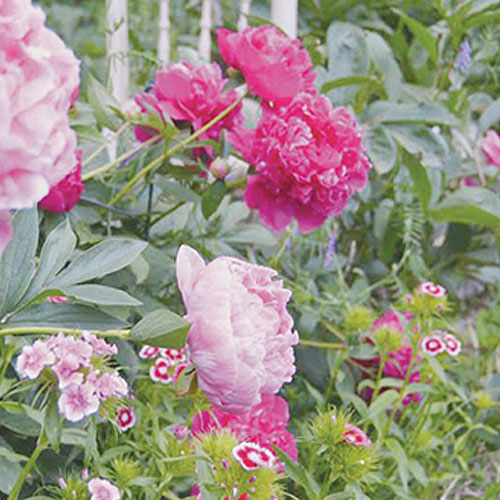
What: Chef Liz Barbour of The Creative Feast in Hollis created a cottage garden in front of her home where dozens of flowers, herbs, vegetables and perennials can be found. The garden is about a third of an acre and includes everything from begonias and daylilies to tulips, peonies and lavender.
When it’s open for tours: Sunday, June 25, noon to 4 p.m. Copies of Barbour’s new cookbook Beautifully Delicious: Cooking with Herbs and Edible Flowers will be available for sale and signing during the tour.
Cost: Free
What to check out: Barbour is known for combining different types of flowers and herbs in the same environment and showcasing unique ways to integrate them into several of her most popular recipes. Behind her house is the part of her garden she calls the “edible landscape,” which is always filled with flowers and baby greens.
Maple Hill Gardens
117 Ridge Road, Hollis, 465-7787, beaverbrook.org
What: On the grounds of the Beaver Brook Association, the Maple Hill Gardens are maintained by a group of volunteers and feature a wide variety of herbs and perennials.
When it’s open for tours: Self-guided tours are available seven days a week from dawn until dusk, now through September. Personal tours can also be scheduled by calling the Association.
Cost: Free
What to check out: Garden manager Paula Babel said visitors will find several themes at Maple Hill Gardens, with many of the more unique perennials making their appearances during the early spring. Check out Alice’s Rockery, which has bleeding hearts, wild blue phloxes, white wood asters and more. Other gardens that are great for viewing later in the year are the Autumn Garden and the Drying Gardens, which feature tall grasses and hydrangeas. The Hedge Garden, with its best viewing times from late May to mid-June, has purple irises, peonies, cranesbills and more.
Petals in the Pines
126 Baptist Road, Canterbury, 783-0220, petalsinthepines.com
What: Petals in the Pines has 26 different themed gardens and grows hundreds of varieties of flowers, including several native plants that grow on the property naturally. You can find daffodils in the spring, peonies and other perennials in the early summer and snapdragons, zinnias and sunflowers in the late summer and early fall.
When it’s open for tours: Daily from 9 a.m. to 6 p.m., from June through early September
Cost: $5 suggested donation per person, or $80 per group of as many people as you want
What to check out: Owner Donna Miller said new themes are put into the gardens every year. Check out some more kid-friendly gardens like the Peter Rabbit Garden, which is designed around the popular children’s book of the same name, or the Fairy Garden, which includes fairy houses made from natural materials. Other favorites include the Rainbow Garden, which contains a whole rainbow of colors from different annuals and perennials in season.
“People get a map when they come with descriptions of each garden, and start their path and go around to see everything that is here,” she said. “They can come on their own or in groups. … It’s a great place for garden clubs or women’s groups or even scout groups to attend.”
Tarbin Gardens
321 Salisbury Road, Franklin, 934-3518, tarbingardens.com
What: Tarbin Gardens has more than five acres of land, featuring English landscape- style gardens with a diverse variety of native and exotic trees, shrubs and perennials. You’ll find different types of flowers that are in bloom depending on the time of year that you visit, like magnolias, lilacs, crabapples or rhododendrons in the early spring, or peonies, foxgloves, roses and more during the summer months.
When it’s open for tours: Public tours are available Tuesday through Sunday from 10 a.m. to 6 p.m., beginning May 2 and continuing through early September
Cost: $8.50 for adults, $7 for children 4 and up, students and seniors, or a $25 maximum per family. Season passes are also available for $50 per person or $75 per family
What to check out: There are several different kinds of viewing areas, like the Formal Garden, which contains begonias, fuchsias and hemlock seedlings, the Catalpa Garden, where you’ll find a blooming display of spring bulbs in early May and foxgloves, campanulas and more in the summer, and the Mother’s Day Garden, which has benches for viewing and relaxing underneath the canopy of a large willow tree.
MORE HEADLINES
A Little Less Sugar
A Little Less Sugar
Margarita Making Alternatives
Written By Stephanie Phillips (food@hippopress.com)
Images: Stock Photo
Cinco de Mayo is next week, along with the Hippo de Mayo taco tour. You’re going to need something to wash down all those tacos, and margaritas are a great option. While I really like margaritas, I don’t like all the sugar that’s in them. Some restaurants make a version with just tequila, triple sec and lime juice, but others use a sugary sour mix that is also famous for causing bellyaches. To avoid all this sweetness, I like to make margaritas at home so I know exactly what is in them.

Last year I went to Texas and discovered moonshine there (which in this case was just alcohol made from cactus that they classified as moonshine). The distillery that made it also made orange liqueur moonshine, and now this is what I use in my margaritas instead of triple sec. I am savoring the bottle because I have not been able to find something similar here in New Hampshire.
Below are my two tried and true recipes for homemade sour mix and a basic homemade margarita. The best thing about these is that you can adjust them according to your own personal taste.
Homemade Sour Mix
First, you need to make simple syrup from sugar and water. I cut the recipe from three cups of sugar to two cups of sugar mixed with three cups water. Boil this combination until the sugar is completely dissolved. (You could use sugar substitutes like Splenda, though the proportions may be different). Let it cool in whatever container you prefer. Once it’s cooled, add two cups unsweetened lime juice (I do not recommend Rose’s as it is already sweetened) and two cups lemon juice. You now have homemade sour mix. Adjust it to your taste as needed; it may be too tart for your liking.
More water can be added to dilute the mix.
You can also add more sugar later, depending on the drink recipe.
Homemade ‘House’ Margarita
For what would be considered a “house” margarita at most bars and restaurants, combine the sour mix with tequila, triple sec/orange liqueur and a few freshly squeezed lime wedges. I typically use three or four parts mix to two parts tequila and one part triple sec, but again this is all personal preference. Sometimes I even like to add a dash of salt. For a frozen margarita, add this recipe to a blender with a few ice cubes and enjoy. You can also add a salt or sugar rim. I prefer silver tequila, but you can use whatever kind you like.
Character! Setting! Magic!
Character! Setting! Magic!
Derry Author Fest Turns 3
Written By Kelly Sennott (ksennott@hippopress.com)
Images: Stock Photo
If you were sad to miss out on Writers’ Day, which was cancelled April 1 due to a snowstorm, never fear — you can still get your fix at Derry Author Fest Saturday, May 6, from 10 a.m. to 4 p.m. at the Derry Public Library.
The event, now in its third year, features many of the gems people like so much about the New Hampshire Writers’ Project’s annual shindig, including workshops, panels and the opportunity to meet with published and unpublished writers. The best part? It’s free.
Erin Robinson, DPL teen librarian who’s also a published author (she goes by her maiden name, Erin E. Moulton, for her books), said the event has seen continued interest among patrons, plus readers and writers outside Derry.

“The news is spreading a little bit. At the end of last year, one lady came up to me and said, ‘This is wonderful! Sometimes, to go to a conference like this, I have to pay a huge amount of money, so I don’t mind putting extra gas in the car to get here,’” Robinson said.
Library Director Cara Barlow conceptualized the first event in an attempt to create more active programming for library patrons. She has continued on this path, recently initiating the creation of Derry’s first poet laureate position, held by Robert Crawford, who will kick Author Fest off with a poem.
This year’s festival theme is “Character! Setting! Magic!” Most of the day is made up of presentations, including those by (Hippo Associate Publisher) Dan Szczesny (“Travel Writing for the Fearless”), Heidi Heilig (“Creating Realistic Characters For Your Fantasy World”), Nicole Tadgell (“Anatomy of a Picture Book”) and Paul Durham (“Middle Grade Magic”).
The only panel, “The Writing Process,” is at the end, featuring Katie Bayerl, Adi Rule, K.R. Conway, Francisco X. Stork and MarcyKate Connolly, moderated by Erin E. Moulton.
“They’re all over the board with the different types of writing they do. It’s interesting to hear their different ways they work through a novel,” Robinson said. “Each session is about the writing process, but the different areas of the process. Some of it is more technical than others. But we’ve definitely had requests for more picture book stuff, and there was also a request for a workshop on developing characters.”
While the workshops aren’t super hands-on — they don’t involve critique — they might have some writing exercises, Robinson said. At lunch, participants can continue their conversations about books and writing at themed moderated tables that tackle topics like crime writing, setting, poetry and picture books.
Robinson suspects the event’s success has to do with Derry’s rich history, having once been home to one of America’s most famous poets, Robert Frost. The Hyla Brook Poets host regular readings at the Robert Frost Farm and workshops at the library, where Robinson also leads a teen writers’ group that sees a steady crowd every other Wednesday.
“It’s really cool. I’m glad there are teens who, during their free time, come to the library to sit and share stories,” said Robinson, who still finds these kinds of meetings and festivals energizing, even as an organizer. “I always benefit from hearing other writers talk about the craft of writing.”
Most authors presenting are from New England, but Heilig, author of The Girl from Everywhere and The Ship Beyond Time, is driving up from Brooklyn. Her presentation is about creating rich, diverse characters with depth while writing fantasies.
“When I first started, my biggest problem was actually finishing something. I would get so interested in these little parts of world-building, and I’d go off on tangents. I’d get excited about one character’s whole story and realized I wasn’t writing a book — I was just writing a world,” Heilig said. “The finishing part of it was going through the story and creating a plot with a beginning, middle and end. … I had so much fun shoveling sand into the sandbox, but the hardest part is building something with that sand.”
Derry Author Fest
Where: Derry Public Library, 64 E. Broadway, Derry
When: Saturday, May 6, from 10 a.m. to 4 p.m.
Contact: derryauthorfest.wordpress.com, RSVP requested, call 432-6140
Schedule
10 a.m.: Travel Writing for the Fearless with Dan Szczesny, followed by book signing
11 a.m.: Creating Realistic Characters For Your Fantasy World with Heidi Heilig, followed by book signing
Noon: Lunch break; purchase a sandwich and take part in themed table discussions with moderators, including Dale Phillips (crime writing), Ginger Johnson (setting), Robert Crawford (poetry), Jennifer Morris (picture books), Carol Gordon Ekster (reading picture books)
1 p.m.: Anatomy of a Picture Book with Nicole Tadgell, followed by book signing
2 p.m.: Middle Grade Magic with Paul Durham, followed by book signing
3 p.m.: The Writing Process, panel with Katie Bayerl, Adi Rule, K.R. Conway, Francisco X. Stork and MarcyKate Connolly, moderated by Erin E. Moulton, followed by book signing
Go Wild
Go Wild
Discover WILD New Hampshire Day Returns
Written By Matt Ingersol (listings@hippopress.com)
Images: Stock Photo
Explore all that the outdoors has to offer at New Hampshire Fish and Game’s 27th annual Discover WILD New Hampshire Day, which features wildlife presentations, scavenger hunts, fishing rod casts, archery and BB gun demonstrations and more.
The rain-or-shine event will be held on the department’s grounds in Concord on Saturday, April 29, from 10 a.m. to 3 p.m.
“It’s a fun and educational event about how people can be connected to life outdoors,” said Mark Beauchesne, advertising and promotions coordinator for New Hampshire Fish and Game.
Beauchesne said the event first started specifically as an Earth Day celebration but has expanded over the years to include representatives from several types of outdoor and conservation-based organizations. They will appear as exhibitors showcasing informational booths and offering demonstrations. It is New Hampshire Fish and Game’s largest annual community event, drawing close to 10,000 visitors each year.
More than 100 local exhibitors are expected to attend for the duration of the festival. Longtime participants include the state Department of Agriculture, the state division of the Appalachian Mountain Club and the state Department of Environmental Services. But other non-government organizations like the Squam Lakes Natural Science Center and the New Hampshire Falconers Association also come to set up shop.

“Most [of the exhibitors] have some sort of educational component that they bring to their booths,” Beauchesne said, “or they might offer hands-on activities or some sort of craft project. The Falconers Association, for example, will bring live birds of prey and talk about different types of species, so that’s always one of the more popular exhibits.”
Another highlight for this year’s festival will be an appearance by cast members of the Animal Planet television series North Woods Law: New Hampshire. The show premiered in early March and follows the daily duties of several Fish and Game conservation officers.
Kids are invited to participate in a scavenger hunt for a chance to win fun takeaways that is meant to also be educational in nature.
“When they first walk into the festival, they’ll get a form with questions to answer that the exhibitors provided about their missions,” Beauchesne said, “and their task is to find the exhibitor that can answer that question and they’ll get a stamp to put down on their sheet. If they can fill the whole sheet by the end of the day they’ll get a prize.”
Beauchesne said the festival is a great time for kids and families of all ages.
“It’s definitely a family outing,” he said. “You might see older teens or high school-aged kids coming who may be interested in this type of outdoors work in the future, so this is actually a great opportunity for some one-on-one time with some of these organizations to ask them questions.”
The exhibitors will be in large tents in the event of inclement weather.
Arnie’s Place and Puppy Love Hot Dogs, both of Concord, will also be there to supply food for a small fee.
27th annual Discover WILD New Hampshire Day
When: Saturday, April 29, 10 a.m. to 3 p.m.
Where: New Hampshire Fish and Game Department, 11 Hazen Drive, Concord
Cost: Free admission and parking; costs apply for food
Visit: wildlife.state.nh.us
No dogs are allowed on the grounds unless they are service dogs
Biomass Woes
Biomass Woes
What’s Behind the Struggling NH Biomass Industry
Written By Ryan Lessard (news@hippopress.com)
Images: Stock Photo
Earlier this month, the Indeck Energy biomass plant in Alexandria announced it was shutting down. And if market prices or regulations meant to help renewable energy providers don’t change, the state’s remaining plants could soon follow.
“There will be hundreds of jobs lost, literally,” said Hunter Carbee, a procurement forester with North Country Procurement.
Economics
Carbee procures and sells the wood that’s burned in biomass plants, which turns heat energy from burning wood into electrical energy. His whole business is with biomass energy, and right now he sells his wood predominantly to the Pinetree Power plant in Tamworth.
He said the problem with the biomass industry is not like anything seen before as the plants are operating at a loss right now, and the reason is twofold.
The larger force at work is the very low price of biomass energy sold in the wholesale market.

“The price in the past year or two years has been significantly low. There’s less demand, we’ve had warmer winters and natural gas has come in to replace what was coal and oil, and natural gas was much cheaper as a fossil fuel,” Carbee said.
As a result, the economic forces are pushing everything toward more cheap natural gas.
Secondly, the reimbursement rates under the state’s Renewable Portfolio Standard law are too low to make a difference. Carbee said the renewable energy certificates are meant to be incentives to strengthen renewable energy generators by filling the gaps in the prices. The goal is to ensure the state has 25 percent renewable energy sources by the year 2025.
There is a bill that passed the Senate that aims to raise the reimbursement rates in an effort to save the ailing biomass industry. It’s currently being taken up by the House Science, Technology and Energy Committee.
Worst Case
If the state loses its biomass plants, it will result in the loss of jobs and have a number of other negative ripple effects as well, Carbee said.
One effect is the impact on New Hampshire forests.
With the closing of several New England paper mills, biomass plants are now the last remaining buyers of low-grade wood, essentially the scrap that foresters can’t sell to anyone else.
If there isn’t a market for low-grade wood in the region, a lot of scrap will be left in the forest.
That could result in an increased risk of forest fires and invasive insect infestations. There may also be a negative aesthetic effect when it isn’t fully cleared of unusable wood.
The loss of biomass will also make the energy market more volatile, according to Jason Stock at the New Hampshire Timberland Owners Association.
“Although it’s not a huge chunk of power, they do provide a nice hedge to the fluctuating natural gas market,” Stock said.
Unlike most other renewable energy sources like wind or solar, biomass is constantly running 24/7 and the plants are strategically located throughout the state so they don’t have to transmit the power very far.
There are plants affiliated with or owned by Eversource in Portsmouth and Berlin and independent plants in Bethlehem, Whitefield, Tamworth, Bridgewater and Springfield, according to Stock.
Take those away, and you could exacerbate the energy prices in the state.
Stock said the state already gets most of its energy from natural gas, about 50 to 60 percent. That makes the state vulnerable to the kinds of price spikes like those seen in the 2013 to 2014 winter. In periods of high demand like that, supply can’t keep up.
If the state is even more reliant on natural gas, Carbee said, a bad winter could cause prices to skyrocket further.
There are smaller biomass generators that supply heat and hot water to places like Winnisquam Regional High School in Tilton and the state health department building in Concord. Stock said that while they aren’t affected directly by the economic forces of the energy market, they could find it harder to find wood chips to fuel the generators if all the biomass plants go belly up. That’s because the power generators use a lot of wood, Stock said, about 1.2 million tons a year.
“The volume that [smaller heat generators] consume … it’s very difficult to justify owning and operating a chipping crew,” Stock said.
Weekly Music Review
Weekly Review
The Obsessed & More
Written By Eric Saeger (news@hippopress.com)
Images: Album Artwork
The Obsessed, Sacred (Relapse Records)

The genre designation “doom metal” is one way of saying “stuff that sounds like old Black Sabbath,” but no one has the basics down as much as this band, led up by Scott “Wino” Weinrich, whose voice was a dead ringer for vintage Ozzy Osborne, warts and all. A Maryland native, he’s been getting away with this Ozzy soundalike business since 1979, fronting (as guitarist/singer) both this band and Saint Vitus, the latter of which, as SST Records’ token metal signing, were basically that label’s metaphorical head on a pike, a constant reminder that corporate arena-rock could always reassemble itself and come back to send the punk rockers scampering back to the drawing board. Thirty-five-plus years into this act, which has seen many ups and downs, Wino still wants to rawk oldschool, but this record isn’t (totally) a collection of “Sabbath or Not Sabbath” trivia quizzes. On “Razor Wire,” a mid-speed raunch-n-blues exercise that sounds lifted from the Molly Hatchet playbook, he relies more on Ronnie Van Zant rasping than Ozzy nasality, while his vocals on the Motorhead-spazzing “Punk Crusher” will make you think of Glenn Hughes (yes, there are certain older hard-rock nerds who still get wildly excited at that reference). Nothing out of place here, more a time-card punch than anything, but really, you weren’t expecting more than that I hope.
Grade: B-
US Weekly, US Weekly (Night Moves Records)

I have to laugh about this one. Music-reviewing can be such a lonely undertaking these days, what with 10,000 new albums coming out every day, and you end up feeling like you’re missing the boat on some obscure band or trend or whatever. But catching one of our own red-handed with a goof is — well, it’s awesome. Case in point: this album, from a coed indie band from Austin, Texas, has been getting a ton of mileage from a rave writeup from Gerard Cosloy, who I used to think was King of All Music Reviewers. He absolutely wigged about this band, referring to their scattershot emo/Pavement/Iggy/Led Zeppelin approach in the glowingest of terms. I sort of sat back after listening to this LP and had to let that sink in. Man, Gerard’s gotten old! Has he forgotten about the Pixies and Black Lips? I mean, that’s what this amounts to, either of those two bands, upfitted with Drive Like Jehu’s strain of punk rabies. College radio is going to flip out over this, but Now You Know The Rest of the Story. You’re oh so welcome. (Seriously, am I missing something with regard to these guys?)