
FEATURED HEADLINES
Food: A Lesson In Coffee
FEATURED FOOD
A Lesson In Coffee
Manchester Cafe Offers New Coffee Boot Camp Series
Written By Angie Sykeny (asykeny@hippopress.com)
Images: Stock Photo
If you’re curious about coffee trends like cold brew and latte art, or if you just want to know the secret to making a good cup of coffee, the new Coffee Boot Camp series at A&E Coffee & Tea’s Manchester cafe has you covered.
The series includes four classes, each on a different coffee-related topic, and will be held monthly, May through August, starting with the “How to Make the Perfect Cup of Coffee” class on Wednesday, May 17.
A&E has offered drop-in educational programs sporadically in the past, but Coffee Boot Camp is the cafe’s first formal class series.
“Coffee shouldn’t be a mystery, especially here in New England where everyone drinks it,” A&E owner Emeran Langmaid said. “But a lot of people who drink it and enjoy it still don’t understand it, so these classes will help to demystify coffee for them.”

The May class will begin with a general discussion of what coffee is; coffee’s history and origins; the steps required to get coffee from the bean to the cup, and the different types of processes that are used; and the science behind brewing coffee. Then, using what they learned about the components of coffee and how it’s made, participants will go through the process of making and tasting their own coffee. They’ll experiment with various measurements and techniques to find out what makes a good cup of coffee and what makes a bad one, and what creates different styles of coffee, from lightly flavored to strongly flavored coffee.
“I really wanted to start the series with showing people how they can make a great cup of coffee at home,” Langmaid said. “Even if you make coffee every day, you may not pay attention to what goes into it, so [at the class] we’ll be diving into why we go through these steps and how important they are in the [coffee-making] process.”
The class will end with a coffee and chocolate pairing session, featuring chocolates from La Cascade du Chocolates of Hooksett, which supplies A&E with the dark chocolate sauce used in its mochas and other specialty drinks.
“That part is just for fun,” Langmaid said. “It’s fun to taste how different coffees react and relate to different chocolates.”
The June class is “How to Make the Perfect Cold Brew,” which will cover the basics of cold brew coffee, the various methods of making it and what kinds of coffees work best as cold brew, followed by a tasting to compare methods, blends and single origins.
July’s class is “Super Simple Espresso,” which will teach the basics of espresso, the relationship between its components and how to make it, and the final class, in August, is “Latte Art Maestro,” about the science of milk steaming and how to use it to create latte art.
In addition to the Coffee Boot Camp series, A&E plans to host new standalone classes on other topics including coffee roasting and demystifying tea.
Langmaid said the classes are an opportunity for people who don’t work in the coffee industry to learn some of the same curriculum that is taught to A&E staff during training.
“We’re taking this material that professionals use and we’re making it more inclusive and approachable,” she said. “You don’t have to be a coffee guru to appreciate this.”
Coffee Boot Camp
Where: A&E Coffee & Tea cafe, 1000 Elm St., Manchester
When: Classes held one evening a month, May through August
Cost: $45 per class. Deadline to register is the Monday before the class. Buy two tickets and get $20 back at the door. A discount will also be applied for buying tickets to all four events in the series.
More info: Call 578-3338 or see event listings at facebook.com/aeroastery. Tickets can be purchased at eventbrite.com.
Schedule
Class #1: How to Make the Perfect Cup of Coffee, Wednesday, May 17, 6:30-8:30pm
Class #2: How to Make the Perfect Cold Brew, Wednesday, June 21, 6:30-8:30pm
Class #3: Super Simple Espresso, July date TBA
Class #4: Latte Art Maestro, August date TBA
News: Mooo Hampshire
FEATURED NEWS - * COVER STORY *
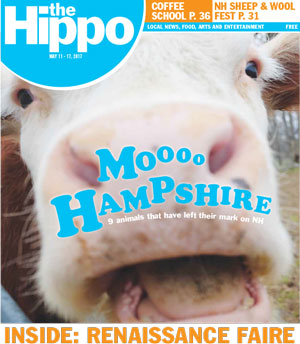
Mooo Hampshire
Nine Animals that Have Left Their Mark on NH
Written By Hippo Writers (news@hippopress.com)
Images: Stock Photos
Old Timers
Moose
Before European settlers arrived in New Hampshire, there were more moose in the state than there were deer, according to New Hampshire Fish and Game. In the 1700s and 1800s, the moose population began to suffer at the hands of the settlers and Native Americans, who killed moose to use for food and clothing. By the mid-1800s, the population had dropped below 15 moose.
“There was no such thing as Fish & Game laws back then. It was unrestricted,” said Kristine Rines, wildlife biologist and Moose Project leader for New Hampshire Fish and Game.
“They killed moose at high levels, and that caused them to decline.”
In 1901, legislation was passed by Fish & Game to close moose hunting permanently, and it wasn’t until the early 1970s that the moose population started to make a significant comeback. By the time New Hampshire held its first regulated moose hunt in 1988, there were over 4,100 moose. This year, 51 moose hunting permits will be issued by Fish & Game via a lottery (applications due May 26), allowing hunters nine consecutive days to hunt starting the third Saturday in October.
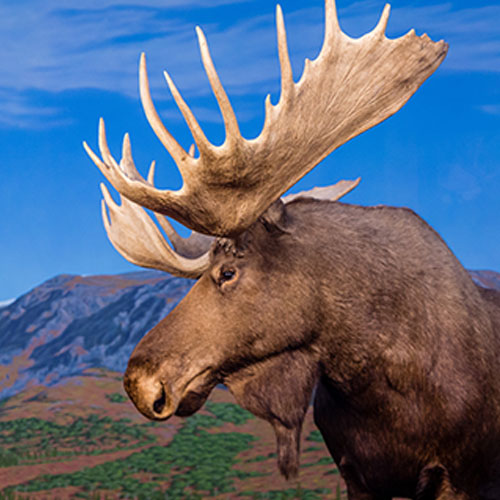
The average weight of a moose in New Hampshire is 1,000 pounds, making it the largest mammal in the state. New Hampshire’s climate and forests, particularly in the northern part of the state, provide an ideal environment for the moose to live.
“It evolved in the north and is perfectly adapted for the cold and the snow,” Rines said.
Moose are herbivores and feed on fresh growing leaves, twigs, tree buds and shrubs. They avoid mature forests and fields and reside mostly in forests with clear-cutting or forest fires, where young plant growth is most prevalent.
“As far as their environmental impact, moose keep forests in a young state, which is great for many kinds of birds which like the younger forests as opposed to old forests,” Rines said.
After the first moose hunt, the moose population in New Hampshire continued to grow, reaching between 7,000 and 7,500 moose in the late 1990s. The current population, however, is declining again due to a new threat.
“Our climate is changing and our habitats are changing and because moose are a northern species, they’re the ones that feel the change the most,” Rines said, adding that the warmer weather also supports new parasites that the moose aren’t equipped to handle.
“The best thing we can do for them is reduce our carbon footprint,” she said.
Sea Lamprey
With a long, snake-like body and circular mouth filled with rows of cartilage teeth, the sea lamprey isn’t as scary as its appearance suggests, says Helen Dalbeck, executive director at Amoskeag Fishways Learning Center in Manchester.
“They are not a well-loved fish, mostly because they’re misunderstood,” she said. “Many people don’t like to see them because they think they prey [on] sports fish, but they actually don’t kill any fish.”
New Hampshire’s cold waters are perfect for the sea lamprey, which is born in rivers and migrates to the ocean where it spends its adult life, then returns to the rivers to spawn.
The lamprey’s contribution to New Hampshire river habitat is unique because it carries marine nutrients from the ocean that aren’t typically found in freshwater and releases them into the rivers when it dies, where other plants and animals can pick them up.
Native Americans and early settlers in southern New Hampshire used to eat the sea lamprey, which was known at that time as the “Derryfield Beef.”
“They were considered a staple for people who lived in this area,” Dalbeck said. “They would especially feed them to children because there were no bones in them.”
They’re no longer eaten in North America, she said, but are still considered a delicacy in some parts of the world, such as Portugal.
Lampreys use the rocky river bottom to build their horseshoe-shaped nests, which protect their eggs from being swept away. They release tens of thousands of eggs after which point they die.
Baby lampreys, which look like tiny worms, find a sandy bottom of the river after they hatch and bury themselves. They use a unique feeding method in which they pop up their heads and filter nutrient particles out of the water as it flows by. Lampreys stay in this state for up to seven years before reaching adulthood and migrating to the ocean, where they can reach three feet in length. As adults, they are parasitic eaters.
“They suction-cup their mouth to the side of a fish and drink its blood and body fluids,” Dalbeck said, “and that’s their source of food, but they don’t kill it.”
Part of the lamprey’s value for us today, she said, is that it’s a cool animal to study and claim as part of New Hampshire’s wildlife.
“Their feeding adaptation and life cycle are so unique in nature. There’s really nothing like the lamprey,” she said. “They have our respect, for sure.”
Deer
White-tailed deer are native to New Hampshire, and to most of the country, residing in almost every state except Utah, Nevada and California, according to the New Hampshire Fish and Game website. Even before colonists came over, they were important resources for Native Americans, providing food, clothing and tools (made from antlers). The animals are tan to reddish-brown during the summer, grayish brown during the winter, and earned their name by showing the white underside of their tails as a danger warning.
Dan Bergeron, deer project leader with New Hampshire Fish and Game, said the state has been tracking populations since the 1920’s. Numbers began to decrease in the 1940’s due to unregulated hunting and predator abundance but were at their lowest in the late 1970’s and early 1980’s, which is when New Hampshire Fish and Game obtained authority to manage numbers, mostly through hunting licenses. It was designated the state animal in 1983.
Bergeron said you’re more likely to see white-tailed deer in the fall during breeding season, when they’re most active and looking for mates. Today, they’re most densely populated in southern New Hampshire’s suburban counties, where hunters are scarce, gardens are plentiful and winters are milder — generally.
“A large part of that has to do with, when you have more development, it’s harder to get people to hunt [in that area] to bring deer densities down,” Bergeron said. “When you have these suburban areas, there’s still a decent amount of forested landscape. You also have these areas where there are gardens and ornamental plants. Deer eat just about everything. Often, what’s planted in yards is also more nutritious than what you’ll find in the woods.”
Numbers in the Granite State are low compared to the estimated 30 million nation-wide, but historically, they’re up in New Hampshire, with about 100,000 or 13 per square mile.
Bergeron said most residents enjoy seeing deer, which are capable of living about 15 years — so long as they’re off the highway and out of the gardens.
“Overall, [the relationship] is pretty positive, and that’s because we have a healthy number of deer throughout the state,” Bergeron said.
The species is important to the state’s economy. People travel to hunt deer — which means they’re purchasing gas, lodging, food and items at local sporting goods stores. In 2011, it was estimated hunting contributes $60 million to the state’s economy. For many families, venison remains a staple meat.
“Some people still rely on wild game for a good portion of their food,” Bergeron said.
Wolves
According to Patrick Tate, a furbearer biologist with New Hampshire Fish & Game, there has actually not been a confirmed sighting of a wolf in the Granite State since 1895, though two cases have been documented in northern Maine over the last 25 years. Still, he said, northern New Hampshire’s heavily forested terrain does serve as an environment that could support a species of wolves.
“As the colonization of European settlers occurred throughout the Northeast, [the wolves] that were here were pushed back mostly through habitat change … and the animals retreated farther north to where humans were less dense,” Tate said. “They moved north eventually up to Canada through population migration. … It was not a conscious decision for them, it was just that the habitat was not favorable for them and reproduction was not favorable on a colonized landscape.”
Today, your best shot at seeing a wild eastern timber wolf is north of the St. Lawrence River in the area of Quebec City, Canada. But Tate said that eastern timberwolves did exist in the Granite State during colonial times. Gray wolves, which are smaller in stature, are also found in Canada but did historically occupy New Hampshire.
“Currently, we haven’t had any physical evidence [in New Hampshire] to absolutely say a wolf has been here, but we do receive pictures from people asking if it’s a wolf or a coyote and having our biologists look at the characteristics of it,” Tate said.
If you’ve ever spotted a wild dog in your neighborhood, you might have asked yourself whether it was a wolf or a coyote.
Coyotes are slightly smaller than wolves on average, with a pointier snout, smaller feet and shorter legs.
Although there is a genetic overlap due to interbreeding between the eastern timber wolf and the eastern coyote, Tate said, the reason why there are only coyotes here and not wolves has to do with each animal’s adaptabilities.
“Coyotes can take advantage of many different types of prey species and habitat types, even in city environments,” he said. “Wolves on the other hand don’t have the ability to do that because they tend to pack more in groups.”
While coyotes don’t prefer to hunt domestic animals or even to attack humans, Tate said, it’s a good idea for owners of small dogs not to let their pets have free range outdoors during its peak breeding season, which is normally from January to March.
“It’s a species that prefers natural food resources,” he said. “We don’t recommend trying to feed them either because of the risk of attracting other unwanted wildlife like bears in the summer months or bobcats in the winter months.”
Workers
Sheep
A period of sheep mania in the early 19th century caused sudden and long-lasting changes to the New Hampshire landscape and helped to shape its early commercial agricultural heritage.
Tom Wessels, a historian with Antioch University of New England, said it all started when a diplomat from Vermont named William Jarvis smuggled a few thousand sheep from Spain during the chaos of the Napoleonic wars. These sheep were a special breed called merino that up until that point had been monopolized by the Spaniards.
The merinos were highly productive and their wool wasn’t scratchy and managed moisture better. Wessels said introducing them to the New England area was a huge economic boost in the early 1800s.
“That period of time … it was huge. It was the first sort of large scale market farming opportunity,” Wessels said.
Before sheep, farms in New Hampshire were just self-sustaining. After, they could grow a lot of a valuable commodity and sell it for top dollar.
A few things helped kick off the sheep market around this time. Tariffs were set up for wool imports, making it easier for local producers to compete, and new wool-weaving machines were invented to make textiles on a large scale.
The wool textile industry had its ups and downs over the years that followed, mostly due to shifting tariff laws. While the early wool industry may not have been as large economically as what the dairy industry would become after the Civil War thanks to the advent of railroads, Wessels said, it had the most important impact on New Hampshire’s landscape.
Without sheep, New Hampshire would not have experienced the first major deforestation effort of the 1800s, which turned the land south of the notches into 80 percent agricultural land by the middle 1840s, mostly for sheep pasturage.
And because the wood from the forests was burned, farmers didn’t have enough wood to maintain wooden fences. That led to the creation of stone fences.
“Farmers [would] go back to stone dumps, pick out the rocks and start replacing wooden fences with stone fences,” Wessels said.
Many of those stone fences remain today. Wessels said that there’s now about 125,000 miles of stone fences between New Hampshire, Vermont and Maine. That’s enough to wrap around the earth’s equator five times, reach halfway to the moon in a straight line or pile up to mounds six or seven times as massive as all the Egyptian pyramids, according to Wessels.
The sheep industry turned a corner in the middle of the 19th century when the cotton gin made cotton textiles more competitive and overgrazing in New England made soils degrade and productivity decline.
Ultimately, the industry moved westward with much of commercial agriculture. But over the past 20 or 30 years, Wessels said, small specialty farms in New Hampshire have made a comeback. Today, some farms have sheep that they grow and sell for meat to restaurants. Even sheep milk has been used for specialty products like cheeses amid the locavore movement.
Cows
Cows have an enormous role in New Hampshire’s economy, culture and landscape — even though they’re relatively new to the Granite State, having first come over with early settlers.
In fact, until 150 years ago, most of our farms were sheep farms, supplying wool to nearby textile mills, from Manchester to Lowell, Mass., said Carl Majewski, food and agriculture UNH Cooperative Extension field specialist. When the textile industry moved south, New Hampshire farmers turned to dairy production instead, capitalizing on recent technological advancements in bottling and transporting milk.
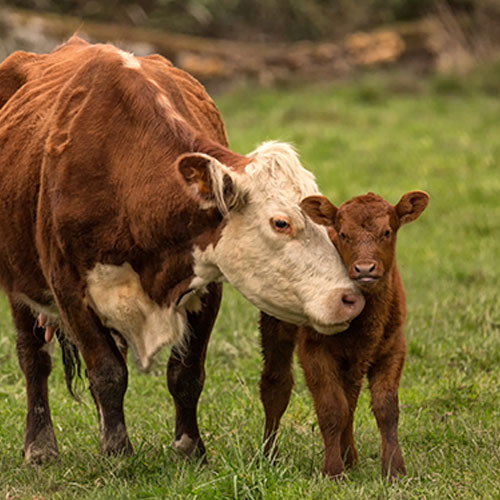
New Hampshire farmers also turned to dairy because the climate is good for growing grass for cows to eat — fruit and vegetables, not so much.
“A lot of the state has rocky, hilly soil, and we’ve got a somewhat limited growing season. That makes it hard to grow some crops on a large scale. That’s why there are millions of acres of vegetables in California and not here,” Majewski said via phone. “But we do grow a lot of grass. And while it’s a pain to go harvesting grass on some of these rocky, hilly soils, you can have cattle out there grazing and it’s just fine.”
Cows can live as long as 12 years depending on their breed and prefer moderate temperatures, between 50 and 60 degrees. New Hampshire’s not the most cow-dense state in New England — both Vermont and Maine have us beat — but cows and other farm animals are to credit for a great deal of the state’s pastoral landscape.
“Dairy and beef farms are what give a lot of the state its rural character. Of all the different types of farming that go on in the state, anything to do with animals takes up more land than anything else. There are a lot of hay fields, a lot of pastures and corn fields,” Majewski said.
Majewski estimates peak cattle populations were in 1900, with around 115,000 milking cows. Today, cow population numbers have dwindled, with the last census conducted by the United States Department of Agriculture counting 33,392 New Hampshire cows on 1,091 farms in 2012. Of those, 13,474 were active milking cows (mostly Holsteins), 4,075 beef, the rest calves or inactive milking cows (a variety of breeds). Majewski said the industry continues to change.
“More and more, there are farms … that are bottling their own milk and selling it directly to consumers, or selling it directly to supermarkets,” he said. “I think New Hampshire does rank fairly high in direct farm sales to consumers. There are a lot of people looking to support local farms, who want to know more about where their food is coming from, and how it gets there.”
Rebounders?
Turkeys
For about a century, New Hampshire didn’t have any wild turkeys to speak of. But thanks to restoration efforts, they’re now more populous than they were estimated to be before the colonial period.
Ted Walski, who has led the turkey restoration effort at New Hampshire Fish and Game for the past 40 years, said there were an estimated 5,000 wild turkeys in the state during the pre-colonial era. They were hunted for food by Native Americans but with the advent of European settlers and more advanced firearms, the birds were over-hunted and eventually extirpated, after much of their habitat had been destroyed by farmers clearing away huge sections of forest.
The last turkey was spotted in Weare in 1854.
After more than a century, the state decided to take steps to bring the fowl back.
Walski said turkeys were a true native to New England and hunting them was part of the culture here.
“It’s been a huntable species in so many states. … It was almost our national emblem or symbol instead of the eagle. And it was a valuable food source … used by the Indians and the early settlers here,” Walski said.
And hunting turkeys takes a great deal of skill, according to Walski. Hunters have to get up extremely early and it teaches them how to call turkeys and be patient.
“You have to be pretty close to be able to get a turkey so it makes overall better hunters,” Walski said.
The first stab at bringing turkeys back to the state was in 1969, when New Hampshire traded 26 fishers for 26 turkeys from West Virginia.
That plan failed for a few reasons. Walski said the fowl from West Virginia were not a particularly hardy species and two severe winters in a row killed most of them off. In addition to that, the birds were released in Pawtuckaway State Park, which didn’t have the kinds of farmland and hayfields that turkeys thrive in.
Turkeys eat a lot of protein. In the spring they like to eat a lot of grasshoppers found in fields, then they eat more berries in the summer and nuts and seeds in the fall. Grasshoppers are usually found in open fields and farmland.
The second attempt to transplant wild turkeys was successful. They obtained a donation of 25 turkeys from Allegany State Park in New York and relocated them in Cheshire County along the Connecticut River in 1975.
After only three years, Walski was able to start trapping dozens of turkeys at a time and moving them more eastward. He did this about 15 times over the next several years.
Because turkeys are polygamous and lay about 12 eggs at a time, they multiply their population exponentially.
There are now an estimated 40,000 turkeys in the state.
Last year, 3,882 turkeys were taken in the hunting season. This year’s season started on May 3 and goes through May 31.
Loons
Where there are lakes in New Hampshire, there are usually some common loons. In fact, whenever you do see these aquatic birds on the water, it means the water quality of the lake is high.
“Loons are great indicators of the overall environmental health … of our lakes and ponds,” said Harry Vogel, executive director and senior biologist for the Loon Preservation Committee in Moultonborough. “If you have them on a lake, you’re doing something right.”
Loons in New Hampshire are considered a threatened species, with only about 300 pairs recorded by the committee statewide last year. A lake in Canada, by comparison, has about three times as many loons as in any given area of water in New Hampshire of the same size, Vogel said.
“In the early days [of the committee] during the late 1970s, some pretty extensive interviews were done with some longtime residents living on or near our lakes about the abundance of loons,” he said. “Through these types of interviews, we’ve learned that loons were actually much more common in the past than today.”
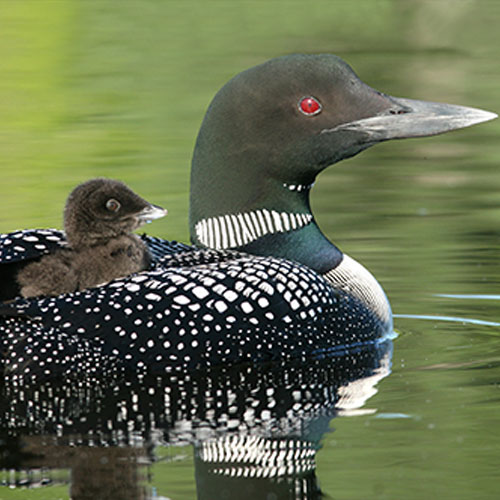
Since then, the committee has been leading the efforts to recover the state population of loons back to where it should be. Vogel said a major factor contributing to the decline in population of loons in the state has to do with lead poisoning caused by fishing equipment. According to New Hampshire Fish & Game, a state law was passed last year banning the sale and freshwater use of lead fishing hooks weighing one ounce or less.
“Loons should be found statewide … [and] there are a lot of different things we can do, but two big ones are to give them space and to not use lead fishing sinkers or jigs,” Vogel said. “The problem is that people always want to get up close to get a picture of them, but you’re always at risk of forcing a loon to abandon its nest if you do that.”
The common loon is one of five different species of the bird worldwide but is the only one that resides in the Granite State. Most of the other species, like the red-throated loon and the yellow-billed loon, are often found in more arctic regions of the Northern Hemisphere.
“There is some evidence that loons are more cold-adapted, and that if they get too warm, they get a little heat-stressed,” said Pamela Hunt, senior biologist in avian conservation for New Hampshire Audubon.
Vogel recommends remaining at least 150 feet away from the birds, and using a good pair of binoculars or a telephoto camera lens if you have one.
If you want to learn more about loons, you can visit the committee’s headquarters, which has various taxidermy displays and a gift shop. The McLane Audubon Center and the Squam Lakes Natural Science Center are also good resources.
Whales
Prior to the 1970s, there was little expert knowledge of whales — in fact, they were thought of as monstrous creatures among the locals, according to Mary DeBerry of Discover Portsmouth, which is part of the Portsmouth Marine Society.
“There were no aquariums or places around back then that were preserving and educating people about whales as a part of marine life,” she said. “It probably wasn’t until the ‘80s or so that there was more of this public consciousness about them and how they are friendly mammals to the environment.”
Rebeca Murillo, program and volunteer coordinator for the Blue Ocean Society for Marine Conservation in Portsmouth, said the most common species of whales you will see in the Gulf of Maine are of the baleen family — minke, humpback and fin whales. Currently, there is a northern Atlantic population of about 11,500 humpback whales and less than 3,000 minke and fin whales.
“Baleen whales don’t have teeth but instead have a kind of filter feeder system on their mouths,” she said. “Minke whales are one of the smallest and only grow about 30 feet long, while humpback whales can grow between 30 and 40 feet and fin whales can reach lengths of up to 70 feet.”
Murillo said humpback whales, the most well studied of the three, were just taken off of the endangered species list last year by the National Oceanic and Atmospheric Association, due to a gradual increase in population.
A large population of whales along New Hampshire’s Seacoast is a good indicator of the health of the ocean, and ways to improve the population of whales involve limiting the amount of trash produced in the water.
Murillo said the presence of these whales helps create a stable food chain for other ocean wildlife. The waste of most whale species helps to promote the growth of different phytoplankton in the ocean, which in turn removes carbon from the atmosphere and helps certain fish and other marine species that depend on that phytoplankton for survival.
Pete Reynolds, captain and owner of Granite State Whale Watch in Rye Harbor, began doing recreational whale watches along the Gulf of Maine in the mid-’80s.
“Our main area where we go is Jeffreys Ledge; it’s basically an underwater mountain chain from Cape Ann to about 20 miles offshore from Portland, Maine,” Reynolds said.
Murillo said the chances to see whales varies as they follow sources of food.
“Certain things to look for [out on whale watches] are water blows in the distances or different kinds of disturbances in the water,” she said.
Want to Learn More About the Sea Lamprey?
Arts: The Big Bicycle Project
FEATURED ARTS
The Big Bicycle Project
Concord to be Decorated with Bicycle-Part Art
Written By Kelly Sennott (ksennott@hippopress.com)
Images: Courtesy Photo
The three bird sculptures that are part of Concord’s Big Bicycle Project were designed by preschoolers. They stand on metal rods and sport gear eyeballs, tire bellies and kickstand feathers.
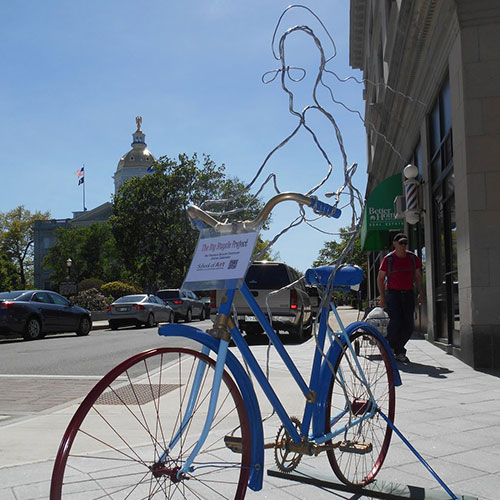
Big Bicycle Project
Learn more at kimballjenkins.com/big-bicycle-project, where there will soon be details and a map on where to find the sculptures.
Music: Unbroken
FEATURED MUSIC
Unbroken
Mayall still has More Room to Move
Written By Michael Witthaus (music@hippopress.com)
Images: Courtesy Photo
At age 82, John Mayall is amidst one of the most prolific phases of his career. That’s saying a lot for a man who helped invent British blues rock in the early 1960s, playing with a Rock & Roll Hall of Fame wing’s worth of sidemen along the way. He cut his teeth backing blues legends John Lee Hooker, T-Bone Walker and Sonny Boy Williamson on initial forays into England.

Film: Guardians of the Galaxy Vol. 2
FEATURED FILM
Film Review
Guardians of the Galaxy Vol. 2 (PG-13)
Written By Amy Diaz (adiaz@hippopress.com)
Images: Movie Screenshot
The misfit gang of accidental universe-savers returns in Guardians of the Galaxy Vol. 2 , a very effortful attempt at recapturing the magic of the 2014 original.
I mean, this movie is working, breaking a sweat, using all its time to clean/never taking time to lean. It’s exhausting.
Peter Quill (Chris Pratt), Gamora (Zoe Saldana), Drax (David Bautista), Rocket (voice of Bradley Cooper) and a tiny Groot (voice of Vin Diesel) are still together, still rocking out to the hits of the 1970s. They work as galaxy-savers for hire, and when the movie opens they are attempting to protect some high-powered batteries from a ferocious thing that we’ll never see again. The batteries, however, will figure into their adventures since Rocket steals a few small ones from this planet full of gold-plated, very persnickety people led by Ayesha (Elizabeth Debicki). She sends her fleet after them once she notices the theft, but our heroes are saved by Ego (Kurt Russell). After Quill’s damaged ship has crash-landed (but is out of danger) Ego explains that he is Peter’s long-lost father and has been looking for Peter in all the years since his mother died back on Earth.

As you’ll recall, Peter was abducted by Yondu (Michael Rooker), who raised him, teaching him to fight and steal. Yondu and, to a greater extent, his crew are still mad about whatever happened between him and Peter in the last movie (I forget, that was so much Marvel universe ago). When Ayesha comes to him to get his help in tracking down the Guardians and the batteries, Yondu agrees to search for him.
For a chunk of the movie, the gang is separated. Peter, Gamora and Drax follow Ego and Mantis (Pom Klementieff), Ego’s empath/one-woman-entourage, back to Ego’s planet while Rocket, Groot and Gamora’s sister Nebula (Karen Gillan), who is being held prisoner, stay with the ship. Yondu and crew show up looking for Peter and capture the ship-based chunk of the Guardians. But a mutiny by some in the crew soon has Yondu and Rocket working together.
Also, Sylvester Stallone shows up in one of those cameo roles that I’ll have to go to the internet to learn the significance of, there’s some Thanos talk (I forget, is he still a thing?) and a certain duck makes another appearance. There’s also a bunch of stuff that happens in the mid- and post-credits sequences — some of which are cute moments related to this movie; some of which, like, man, life is too short.
Ah, what a Marvel movie through and through — from quips to Easter eggs.
What’s the opposite of starting strong but not sticking the landing? What if you can consistently stick the landing after stumbling through the preceding 80 percent of movie? Whatever that’s called, Marvel is frequently pretty good at that. I liked the last, say, 30 minutes of this movie but I wish I could have had some of the good will I ended with during the first hour and 45 minutes.
Though I tried mightily to avoid any early reviews of this movie, I did see a headline on Vulture.com that mentioned “Marvel bloat.” This feels pretty accurate; there is a lot of (do we even need “bloat,” isn’t that just redundant?) Marvel-ing happening in this movie. There’s backstory (some of which I think I’m supposed to remember, some of which may be new), about 30 percent more characters that I can really keep interested in, a central villain whose goal and plan I don’t entirely get (I think it boils down to boredom?), a secondary villain I kept forgetting about and, of course, a lot of quipping and PG-13/middle-school-level insults. I almost feel it’s unfair for me to complain about the quipping, since one of my big problems with DC’s movies (and, indeed, a lot of action movies in general) is how grim and humorless they are. And yet here it feels like “remember how funny the first movie was? We’ve got even more funny in this one! Check out all the funny!” The movie confuses snappy dialogue with joy, and the first movie had a lot of silly joy. Gleeful is how I remember the first movie. Dutiful is how I’ll think about this one.
Which isn’t to say that none of the humor works — there are funny moments. There are moments of cool action. The end is actually kind of stunning for how it pulled together and even made me care and feel feelings despite the fact that an hour earlier I was already losing interest in the movie.
Guardians of the Galaxy Vol. 2 tries way too hard to recapture the loose, “B-level characters just goofing” feel of the original but does have its moments of, if not greatness, goodness.
Grade: B
Pop: Reliving the Renaissance
FEATURED POP
Reliving the Renaissance
H Renaissance Faire Returns to Kingston for Two Weekends
Written By Matt Ingersol (listings@hippopress.com)
Images: Stock Photo
For the next two weekends, Marghi Bean’s property in Kingston will be transformed into a medieval village, with jousting knights, costumed performers and merchant vendors.

New Hampshire Renaissance Faire
MORE HEADLINES
Redistricting Manchester
Redistricting Manchester
Schools Launch Study into Demographics & Facilities
Written By Ryan Lessard (news@hippopress.com)
Images: Courtesy/Stock Photo
The Manchester school district is asking for bidders who would audit the district and submit a report on demographics and facilities so officials can move forward with a plan for redistricting.
Superintendent Bolgen Vargas said in a phone interview that he released the request for proposal May 8, and he hopes the process will move quickly now. He would like to select a third-party reviewer right away and obtain a final report later this year with proposals workshopped and voted on by the school board by the end of the year.
“My hope is we can finish this entire project by December,” Vargas said.
The Board of School Committee debated various strategies for redistricting last year, but according to committee member Leslie Want, it wasn’t going anywhere.
“There were so many opinions and we were a mile wide and an inch deep,” Want said.
Then, last spring, the board created a special committee on redistricting, of which Want is the chair, but it also failed to arrive at a solid plan.
“There were 12 different plans, we got it down to four different plans. Of those plans, three of them had to do with changing grade configurations, which seemed to be very unfavorable when we listened to the principals,” Want said.
While some plans dealt with moving fifth-graders to middle schools and eighth-graders to high schools, other plans would have closed school buildings.
Ultimately, Want said, the work done by the five-member subcommittee proved fruitless because they didn’t have enough information upon which to base a strategy. So they agreed to have Vargas hire an auditor to get the much-needed data and defer somewhat to the superintendent’s broader vision.
While some on the school board, as well as former city aldermen, have floated the closure of Central High School, Vargas said he thinks that can be avoided.
“Everything should be [on] the table, but my vision is larger than that,” Vargas said.
While everything hinges on the findings of the audit, most expect the reviewers to find a surplus of space in the high schools, despite some class sizes’ being too big. Vargas said that surplus space could be used in more innovative ways that would serve as an alternative to closing facilities.
One idea is having a local business or higher ed or community education institution lease space in the buildings. A bank or a biotech lab could open a branch in a school and students might benefit from learning about the business by observing or even working there, Vargas said.
He said this is a spinoff of his proposal to locate the central district offices at West High so they can sell the millyard offices.
The district is in a time of consolidation as it deals with the loss of students from multiple sending communities — compounding a statewide trend of declining enrollment — and a budget deficit.
Vargas said some solutions might be figured out on a case-by-case basis and may not even require the redrawing of district lines.
“We have 22 [buildings] but we don’t have an issue with every building,” Vargas said.
But if the goal is to reduce class sizes and overcrowding, Vargas said, there’s no way to do that without spending more.
“It’s useless to get into an effort if you want to reduce class size and you don’t discuss investing or where the money is going to come from to do so,” Vargas said.
Want agrees that the district will have to hire more teachers and the board will need to come to terms with the cost of that.
“We estimate every classroom teacher costs the district about $50,000. So if you add 20 teachers when you redistrict, that’s $1 million,” Want said. “To me, that’s the biggest issue with redistricting.”
The board already approved the first step in this redistricting process by changing the feeder system for students in certain grade schools to know more predictably which middle and high schools they will end up in. Want said that was the low-hanging fruit.
Vargas thinks the success of getting that system changed was due largely to robust community engagement, and he said any redistricting plan needs to go through the same process.
As for how the larger board will stand on any strategies moving forward, Want thinks it will depend on what the community says at a series of public meetings that will be held around them.
“So the board by that time will have a pretty good idea about how the community feels about it. And then, whether or not it gains support from the board I think will largely depend on those community meetings,” Want said.
Newborn Security
Newborn Security
LRGH at Forefront of Technology for Protecting Babies
Written By Ryan Lessard (news@hippopress.com)
Images: Stock Photo
Lakes Region General Hospital in Laconia has adopted a new technology that will help protect newborns from abduction by using the same high-resolution imaging that’s used for fingerprinting to scan their feet.
“This is relatively very new. Traditionally, nurses in hospitals have used ink to ink a baby’s foot and must make a mirror footprint on a piece of paper that is primarily used as a keepsake for the mother,” said Bill Losefsky, the chief of security services at LRGH.
He said the ink prints or inkless paper methods don’t provide law enforcement with any identifying features. But the CertaScan can be used with the same reliability as fingerprints.
“It was determined that a baby’s footprint has ridges and loops and arches and whorls just like a fingerprint does and is unique to that individual,” Losefsky said.
In fact, the footprint’s identifying characteristics remain the same throughout the lifespan of the individual. So the scanned footprint may prove useful for cases even 80 years after a baby is born, according to Maureen Cassidy, the director of the family birthplace at LRGH.

Cassidy said a foot scan taken at birth can be used to locate a senior with dementia who wandered off, for example.
LRGH is the first and only hospital in the state to use this technology, according to Losefsky. Spokespeople at Catholic Medical Center and Elliot Hospital in Manchester say they have not looked into the biometric scanning method yet.
Lauren Collins-Cline at CMC said the team at Mom’s Place is always on the lookout for new ways to ensure the health and safety of its patients.
Nicole Pendenza, the director of maternity services at CMC, said in an email that evidence has shown that ink prints have proven inadequate for identification, and they’re looking into the new scanning technology.
“We are excited about the new technology that may be available to us in the near future,” Pendenza said.
Cassidy said she hopes other hospitals adopt this technology.
“If we can start here, at Lakes Region … a small little hospital, and put these things in place and show other hospitals this is what you should be doing, then that is our obligation to our patients and to the community,” Cassidy said.
For now, foot scanning at LRGH is only available to infants born in their maternity unit.
At first, Cassidy said, she was concerned about patient privacy and making sure the hospital complies with federal health care privacy laws, but she was convinced that the encryption in the company’s cloud server makes the biometric data and identifying information safe from hacking.
“The failsafes that they have in place [to] ensure for us the safety of our patients, it’s just top notch,” Cassidy said.
Losefsky said LRGH is also the only hospital in the state with a Wi-Fi tracking system for new mothers and babies.
In most American hospitals, when a baby is abducted from its birthing unit, the building goes into a sort of lockdown mode called Code Pink. Staff throughout the hospital stand at every possible exit in the hopes of catching a would-be abductor.
“Once the baby leaves the unit, it’s a controlled Easter egg hunt,” Losefsky said.
LRGH can go beyond that by using short-range Wi-Fi transponders in the baby’s and mother’s wrist bands that can pinpoint their locations even as far as the parking lot.
True Love
True Love
Nashua Actorsingers Cast all Aside for Singin’ in the Rain
Written By Kelly Sennott (ksennott@hippopress.com)
Images: Stock Photo
Passion goes a long way for the Nashua Actorsingers, whose cast and crew dealt with leg injuries, half marathons and cancer to present Singin’ in the Rain this weekend at the Janice B. Streeter Theater.
“When they approached me to be in the show, initially I thought, oh, I don’t know. I was trying to get healthy,” said Seraphim D’Andrea, who plays Lina Lamont and recently finished chemotherapy for breast cancer. “But being in a show feeds your soul. You can get kind of lost being sick. But I’ve been a performer since I was 5, and I was missing that. So I said, OK, I need something to kind of make me have a purpose. To fight through, you need that.”
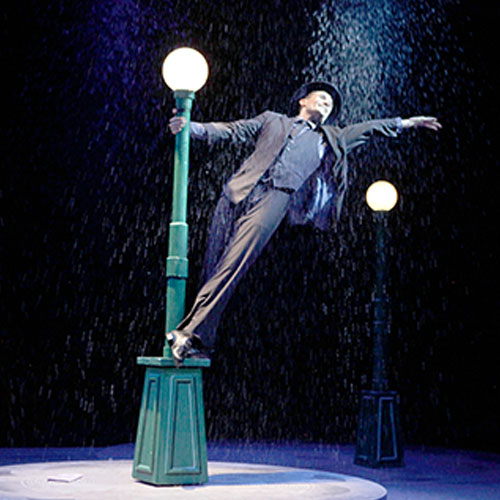
Singin’ in the Rain is a musical based on the 1952 film starring Gene Kelly, Donald O’Connor and Debbie Reynolds, with book by Adolph Green and Betty Comden, music by Nacio Herb Brown and lyrics by Arthur Freed. It was first produced on London’s West End stage in 1983 and is set in the 1920s during Hollywood’s waning days of the silent screen era.
The show presents many technical challenges, from onstage rain to movie projections, and rehearsals have been noisy and full of activity, said the show’s director, Kathy Lovering, during a recent rehearsal at the Actorsingers Studio. That night, cast members were glammed up for press photoshoots, and tap shoes could be heard throughout the building.
But Singin’ in the Rain is known for its tunes and iconic dance numbers, so dancers had to work extra hard when the show’s choreographer, Lara Hyde, suffered a leg injury a month into rehearsals. They had to learn the steps with her in a chair, leg propped up, but they powered through using some of the choreography videos she proactively filmed before rehearsals even began.
“Losing Lara was really hard, but we all kind of rallied behind each other and supported each other any way we could,” said Samantha Kowalski, who that day was feeling the effects of running her first-ever half marathon the weekend before.
The eldest dancer of the group is Alice Pascucci, who vowed to be tapping onstage by her 80th birthday, but Lovering said both cast and crew include multiple people over 80, plus a couple of teens.
All are performing not for money, but for the love of what they’re doing.
“When you do community theater, the community is just as important as the theater. You come here and you have a good time. This is a lot of work; I work full time, and I’m getting old, but you come here after a long day, and it’s fun,” she said.
Singin’ in the Rain
Sheep Trick
Sleep Trick
NH Sheep & Wool Festival Returns
Written By Matt Ingersol (listings@hippopress.com)
Images: Courtesy Photo
Meet some sheep and learn all about the Granite State’s fiber industry at the 41st annual New Hampshire Sheep and Wool Festival.
This year’s festival will be held on Saturday, May 13, from 9 a.m. to 5 p.m., and Sunday, May 14, from 9 a.m. to 4 p.m. at the Deerfield Fairgrounds. A variety of demonstrations, information booths and workshops are planned for both days. The event is hosted by the New Hampshire Sheep and Wool Growers Association.
“The association was established … to educate the public about raising sheep,” said Theresa Walker, a volunteer for the festival’s planning committee, “and the festival started sort of both as an educational outreach program and a celebration of sheep in general.”
The festival has grown into a popular weekend event for families, even those who don’t own a farm or sheep of their own, according to Walker.
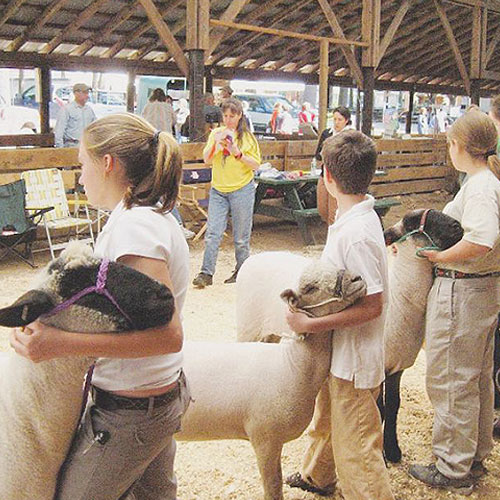
“The shepherds that were coming together [to put on the festival] started realizing there was a public interest in backyard farming,” she said. “We’ve always got families coming out and activities for kids to make all kinds of things.”
Saturday’s festivities kick off with the annual sheep youth show at 9:30 a.m., when young shepherds will present their sheep.
“It’s sort of going to be like an introduction for the local 4-H club to show their sheep on a larger scale,” Walker said.
Nearly 100 vendors will be setting up shop on the fairgrounds, some selling yarn and fiber products and others hosting shearing or knitting demonstrations. Food vendors will also be there selling roasted lamb, lobster rolls, pizza, sausages and more.
Almost every exhibitor is from the New England area, with a majority from New Hampshire, like Purgatory Falls Alpaca Farm of Lyndeborough, The Yarn and Fiber Company of Derry, Smiling Sheep Farm of Milton and several others. Great Bay Woolworks, Walker’s company that produces yarn from Liberty Hill Farm in Durham, will also be at the festival both days.
“There are a lot of seasoned shepherds here who will be sharing their knowledge of sheep shearing and showing off what they love to do,” Walker said. “Many of them sell fiber products that come from their own animals.”
Other staples of the festival will include several workshops to be offered both days, in areas like spindling, beginner’s crocheting and more. The cost to participate in most of the workshops ranges from $45 to $50 and includes admission to the festival.
There will be a used equipment sale under a tent at the festival, featuring fiber panels and other basic barn equipment. A 10-percent commission from items sold at the sale will be paid to the festival’s planning committee.
New to this year’s festival will be a screening of the 2016 documentary film Yarn: The Movie, on Saturday at 5:30 p.m. inside the Concessions 2 building on the fairgrounds. Tickets to attend the screening are $5 for adults and $2 for kids 12 and under.
41st annual New Hampshire Sheep & Wool Festival
Bread of Life
Bread of Life
Baker Tells a Story Through Recipes in New Book
Written By Angie Sykeny (asykeny@hippopress.com)
Images: Courtesy Photo
For Martin Philip, head bread baker at King Arthur Flour in Norwich, Vermont, baking isn’t just a job — it’s an art.

CCANH Salon Series: Martin Philip
Weekly Music Review
Weekly Review
Black Lips & More
Written By Eric Saeger (news@hippopress.com)
Images: Album Artwork
BJohn Yao Quintet, Presence (See Tao Recordings)
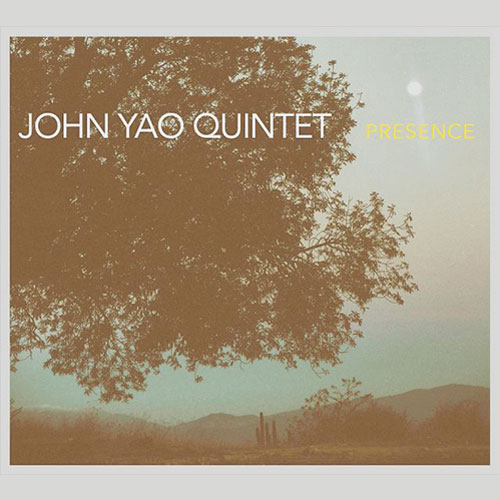
Third full-length from this New York jazz trombonist, continuing his dual approach of post-bop and lounge with one half-lidded eye toward prog. Dedicated to his recently deceased best friend, it’s nonetheless an upbeat jaunt, beginning with the herky-jerky, slightly cartoonish head-bonking bop of “Tight Rope,” which, if it wasn’t so tight, could have sounded like a scrapped Marty Cook outtake. That’s part of the rub with trombone jazz anyway, that “no, it’s not quite a sax” eeriness, which, while we’re here, is assuaged by returning sax player Jon Irabagon, whose shadowing of Yao’s trombone naturally expands the melodies, making some parts sound almost big-band, a nice changeup from the sleepier parts. The title track is of course melancholic in spots, talkative in others, all along displaying Yao’s dexterity with the instrument for which he abandoned piano. The actual ode to his friend, “M Howard,” is eight minutes of complicated sadness that Yao imparts like a champ.
Grade: A
Fast Romantics, American Love (Postwar Recordings)
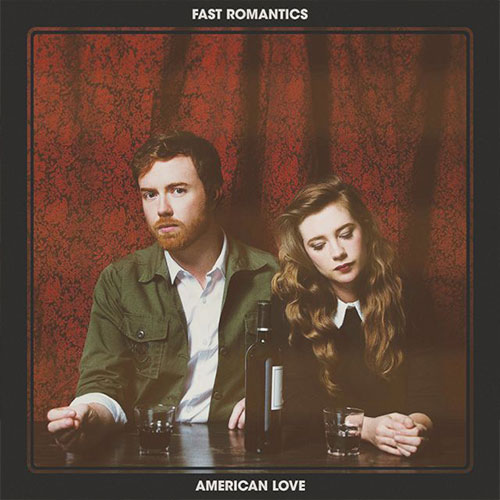
The third LP from this Toronto hayloft-rock sextet is, like their last album (2013’s Afterlife Blues), steeped in fascination with love found at the wrong times. But where ALB went over a topic that’s been tired for decades (trying to make friendship into something more), this time the band’s seized the opportunity to sift romantic love through the bulky screen of the last U.S. election (which dominated Canadian society as much as anyplace else’s), all in order to make a (mellowed out) Born to Run for the Certifiably Nuts Age. Toward this end, Matthew Angus’s off-the-rack Jarvis Cocker-ish baritone wants to be Springsteen, or at least make the poor-man’s-off-Broadway of opener “Everybody’s Trying to Steal Your Heart” into something magically electric, and it does come close, but not the way “Why We Fight” does (maybe because it’s faster and thus more akin to “Born to Run”). In the end, this stuff is valiant but not majestic, falling midway between Decemberists and Bruce at its best (which, come to think of it, is certainly workable in a way).
Grade: A-
Keeping Busy
Keeping Busy
NH Poet Laureate Alice Fogel on A Doubtful House
Written By Kelly Sennott (ksennott@hippopress.com)
Images: Courtesy Photo
Three years have passed since Alice Fogel was appointed New Hampshire poet laureate, and she’s far from slowing down.
Fogel spent the past month conducting poet laureate duties, from hosting workshops and readings to setting new initiatives, and she released her latest poetry collection, A Doubtful House, April 4. Unlike much of her other writing, these pieces aren’t inspired by nature, but by four walls and a roof. They start with a quote from Aladdin: “Phenomenal cosmic power! Itty bitty living space.”
“It’s about people who live together for a long time in a house, and how challenging that is,” Fogel said during a recent phone interview. “I try to look at all aspects of intimate relationships. I think readers will be able to find themselves in these poems.”
Also new for Fogel is the poems’ structure; the lines are set against left and right margins, lining both sides of the page like walls of a room. Woven in the text are elements of realism and fantasy. She likes coming up with new approaches to poetry with each collection she writes.

Fogel recently helped establish the state’s first youth poet laureate position with Andrew Fersch, founder of The Penn (an alternative high school), and just announced the appointment of Portsmouth High School student Emma McGrail to hold it from now through August. The program will be supported by the New Hampshire State Council on the Arts and the New Hampshire Poetry Society. Fogel plans to perform a reading with McGrail at The Word Barn in Exeter in July.
“It’s a way to honor young people,” Fogel said. “Someone like Ella is a perfect candidate for this to start it off. She is so articulate and creative in such a variety of ways. She stands as a representative for youth and can talk to them in a different way than I could, or any other adult.”
Fogel has also been collaborating with Portsmouth poet laureate Mike Nelson in formulating an ongoing writing workshop with local refugees at the International Institute of New England. At the first meeting in early April, about 10 showed up, with representation from five continents. Their goals are to provoke creative expression and offer refugees an outlet to write about experiences and improve their English in a low-pressure environment.
“I’ve been wanting to do this kind of thing for a long time,” Fogel said. “I just love it. I feel like it’s a privilege to meet these people and be a part of welcoming them into a new home. They’ve basically been homeless, some of them for decades. They’ve been through a lot of losses. To be part of their experience of belonging and becoming Americans is incredible. I think everybody in the room felt that connection.”
Her next big venture is what she calls the New Hampshire Raining Poetry project, in which she’ll stencil poems by Granite State poets on local sidewalks with superhydrophobic paint, which repels water. Dry, the words are invisible, only revealing themselves when it rains.
Fogel went through a long process of obtaining permission from selectmen and town businesses in order to install the first poems by Patricia Fargnoli and Henry Walters in front of the Walpole Town Library. At the time of the interview, she was waiting for a few dry days to get painting and had conversed with many New Hampshire poets interested in getting the program running in their towns.
But this May and June, she’s taking a break from laureate duties to delve into one of her other passions, hiking. Fogel, who has tackled about half the Appalachian Trail in patches, plans to explore the trails in Glacier National Park and various parks in Utah. She frequently finds inspiration during these hikes, jotting things down at night for when she returns to her desk at home.
“[Hiking] does seem to be a common trait amongst writers. There’s something about the rhythm of walking that sits with the rhythm of language. There’s also beauty in connecting to the earth and everything we live here with. And poetry is about connecting,” Fogel said.
More Alice Fogel
For other books and upcoming readings, visit alicebfogel.com