FEATURED POP - * COVER STORY *
NH, Center of the Contra Dancing Universe
New Life for the Old School New England Dance Party
Written by Kelly Sennott (ksennott@hippopress.com)
Images: Courtesy Photo
Some people hate Mondays. Naomi and Lydia Hannon love them.
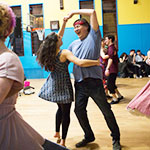
The 21- and 22-year-old sisters regularly attend the Monday night contra dance in Nelson Town Hall, a 150-year-old building seemingly nestled in the middle of nowhere. On a warm September night, the only lights and sounds come from inside — fiddlers play, feet stomp, dancers laugh and the caller announces: “Circle to the left!” “Circle to the right” “Ladies change!” “With your partner, bounce and swing!”
Inside, it smells of fresh-baked cookies and wood, and it’s warm from the 50-plus participants. Many women wear skirts that move as they twirl, and a large portion of dancers don’t wear shoes at all in an effort to preserve the floors. The youngest are students from Kroka Expeditions, an alternative high school in Marlow, and the oldest are regulars who’ve been contra dancing for 30-plus years.
The Hannons, who’ve been attending the Nelson contra dance four years now, first attended at a friend’s suggestion.
“It was magical, which sounds kind of cheesy, but it was! Everyone was so friendly, and we were terrible — we had no idea what we were doing,” Lydia Hannon said. “People came up and asked us to dance, and I was terrified. I was like, ‘I can’t dance!’ They were like, ‘Oh, you’ll be fine! Just smile and have fun!’”
Nelson is known worldwide for its contra dance, having hosted noted callers like Ralph Page and Dudley Laufman, plus musicians like Bob McQuillen, but it’s one of about 20 contra dances occurring regularly statewide. And, like all the state’s contra dances, it’s looking for new people to take the floor and carry on the New Hampshire tradition.
“The dance survives because of new people coming in,” said David Millstone, a contra dance caller and historian. “I often say, if I look out on a dance floor and I know everyone there, the dance is dying. You need new blood. You need new people to constantly keep it alive.”
Contra What?
If you’ve never heard of contra dancing, you’re not alone.
In recent years, many New Hampshire dances were having difficulty getting the word out, and to address the issue, the New Hampshire State Council on the Arts created a brochure about New Hampshire contra dances and gave a grant to the Monadnock Folklore Society and the Monadnock Center for History and Culture to help put together an exhibit in 2015, “Traditional Dance and Music in New Hampshire: 1750-Today,” which traveled the state. Most recently, the Council reached out to young professional groups and offered to sponsor contra dances in the regions they represent.
The contra dance is a descendent of the English country dance, which dates back to the mid-1600s.
“If you’ve seen any of the Jane Austen movies, you’ve seen English country dancing,” Millstone said.

But before it came to the United States, it made its way across Europe — the name “contra dance” dates back to 17th-century French dance masters who called these English country dances contredanses (“opposite dances”). When the dance arrived in America, it was especially popular in rural pockets of New England, including New Hampshire, where in some regions it stuck for centuries.
“Who knows why?” Millstone said. “Part of it may be that these are rural areas, which tend to be more conservative. This is total speculation. Part of it may be that in the cities you’ll find people interested in keeping up with the latest trends.”
Contra dancing has the same traditional folk roots as square dancing, but whereas a square dance consists of four couples, a contra dance set is unlimited, made up of long lines of couples who constantly change partners.
“When you first start telling people about it, they think it’s weird. But dancing with people you don’t know is actually not that strange,” Naomi Hannon said. “It’s cool to meet people this way. We’ve become friends with people we just otherwise never would have met.”
Contra dance aficionados also praise the dance for its accessibility. A caller with a microphone explains the steps before the start of the music, which is usually played live on the fiddle, piano, accordion, harmonica or guitar.
NH Notables
Contra dancing became especially popular in the mid-20th century thanks to a handful of influential contra dance callers and musicians from New Hampshire. Millstone noted two individuals in particular: Ralph Page and Dudley Laufman.
Page, who was born in Munsonville — a village in Nelson — was one of the first to take contra dance calling on as a career.
“Ralph was known as a singing caller. He had a very rhythmic lilt to his calls, and he called regularly for 25 years,” Millstone said.
Page called at the New York World’s Fair in 1939, and by the 1940s he was traveling to call at the Boston YWCA each week and setting up tours that went as far as Japan. Page also composed dances, which Millstone said was prompted by an ad he’d read in the paper — it said Page would be teaching a new dance that night, which Page knew nothing about. Regardless, he whipped one up quickly and continued to compose dances throughout his career.
Page was a strict caller, said Laufman, now 85, during an interview in his Canterbury home. He wouldn’t tolerate things like bare feet or pants on women.
“When he was in Port Townsend one time — there were a bunch of cowboys out there — girls were coming in jeans and the guys were coming in with bare feet or boots. Page got to the microphone and said, ‘I want you women to go put on dresses and skirts, and the guys to put on clean trousers. And I’m not going to call a note until you do.’ And then he went and stood behind the curtain and lit a cigar, and they mostly left,” Laufman said.
Millstone said Page was considered the “dean of New England callers” by the time of his death — he taught a generation of people to contra dance, including Laufman, who first attended one of Page’s dances as a teen.
“I pretty much fashioned myself after Ralph Page. … He was a curmudgeon. Very strict,” Laufman said. “But he was the best. His voice was marvelous. He had a great way of calling.”
Laufman became popular, in part, because he was more open and flexible with the dances he called than his predecessors. People called them Dudley Dances, and he had an open-stage policy, often inviting young musicians, like fiddlers Liz Faiella and Jordan Tirrell-Wysocki, up on stage with him when they were kids.
“I would show up to a dance, and he’d say, ‘Did you bring your fiddle?’ Even if I was just playing a couple of notes, it was really fun and made me feel like I was part of the dance,” said Faiella, now 26.
Spreading The Love
There are a couple reasons Millstone credits Page and Laufman for spreading contra dance popularity.
One, of course, was that they traveled. Their dances were also popular with young people. Events in the Monadnock region and western Massachusetts usually attracted students — i.e., temporary residents — from Smith College, the University of Massachusetts and Hampshire College. (In fact, one of the biggest, youngest contra dances happening today is in Greenfield, Massachusetts, near these schools.)
And then these students moved away.
“Young people were eager to recreate the experience they had of dancing in the small New Hampshire halls. They’d take the dances with them, and the tunes, and start up their own dances,” Millstone said.
Some of them succeeded without help. Others called Laufman and invited him to their new homes in Michigan, Washington or California to do the heavy lifting. Laufman never set up tours, but he was invited to travel a lot, and many of those dances still exist today, Millstone said.
Nelson Dance
As the reputation of Nelson’s callers and musicians grew, so did the town’s, as the place that started it all. McQuillen — who composed contra dance tunes, played with Page and Laufman and was a National Heritage Fellow — once called it the “contra dance capital of the world.”
Lisa Sieverts, a regular Nelson caller, said contra dancers from around the country will stop in if they’re in the area; the most recent visitor was a woman from Homer, Alaska. (Conversely, Nelson residents traveling to other contra dances wearing Nelson garb can become instant celebrities, Sieverts said.)
The dance is also of high prestige because of its age; contra dances have been happening here a little more than 35 years, but the town hall has been hosting events much longer.
“There has been a regularly scheduled dance in the Nelson Town Hall since it was built, in about 1850. And there are records of dances in Nelson going even further back,” Sieverts said.
Today, the Monday night Nelson dance remains largely unchanged — in fact, attending is almost like stepping back in time. Nobody’s on the phone, nobody’s texting.
“We tend to do the same dances every week, and we tend to do the more traditional dances,” Sieverts said. “We’ve never paid our performers. The joke is that everybody performs for cookies. We always have homemade cookies at the dance.”
It tends to be more popular from June to August, when summer residents are in town and kids are home from school, but for a weekly Monday dance, it’s booming, with crowds ranging from 25 to 100. Most contra dances will have one caller and one musician or band a night, but Nelson has several, as per tradition.
It’s one of the only weeknight dances there is, so people travel miles to attend — like Lloyd Carr, who was playing the piano at a recent dance and had driven from Candia. Fiddler Roger Treat had driven from Putney, Vermont, that night.
Advice for new dancers, courtesy of Millstone: Don’t wear shoes with heels. Dress comfortably, and dress in layers for when you start moving. Some venues offer beginner lessons beforehand, but all those interviewed said the best way to learn is to jump in.
Evolving Styles
Much about contra dancing has remained the same. The venues, for one — they’ve always been in town or grange halls.
But there have been some changes.
“Basically, it’s the same now as it was then, except the dances themselves are different. … The dancers and the atmosphere were the same, but the dances [today] have to be taught. … And the music has a different sound. It’s played faster,” Laufman said.
Many venues have spiced things up, with techno dances and black lights and musicians who play brass instruments or electric guitars.
“Definitely, the music has changed. If you look at articles in the newspapers from the 1950s — even the 1920s or the late 1800s — it’s always talking about how it’s adapting to the popular music of the time. It’s becoming jazzier, or becoming more rock ’n’ roll or more techno. It’s a story that repeats itself over and over again,” Sieverts said. “There’s nothing new about the fact that it’s still changing. It’s been changing since 1800.”
Other organizations have begun hosting hot contra dances, which essentially means faster-paced. Some encourage more freestyling, some more gender fluidity — women dance the men’s parts and vice versa.
“But most everyone says they don’t want that to replace traditional acoustic music — that it’s just fun to have something different to dance to,” Millstone said.
Faiella has seen these variations too, but for the most part she thinks the New Hampshire dances remain pretty traditional compared to those outside the state. Not that this variety is a bad thing.
“I think that variety can actually bring more people in,” Faiella said. “Contra dancing doesn’t fit in one box; it is this very traditional … kind of thing, but it’s also very relevant now because of the renovations that are happening in terms of music and dance.”
One of the biggest modifications, Millstone said, has nothing to do with style, but rather the attention given to the musician.
“There are now bands that are touring and making a living from playing this kind of music. In many instances, the music has gotten much more professionalized, more polished,” Millstone said. “Another thing is, the bands are now being featured more than the callers are.”
This change opens doors for people like Faiella, who performs at contra dances with her brother, Dan Faiella, around the region, and Jordan Tirrell-Wysocki, who just stepped back into the folk music world. Both started attending contra dances as kids.
“It feels almost like returning home, when I go to play this music I learned 20 years ago, and I see people dancing the same dances I remember as a kid,” he said. “One of the great things about the contra dance community in New Hampshire is that it’s so welcoming to people of all levels of experience, whether you’re musicians or dancers.”
Skipping Generations
Contra dance popularity often occurs in waves, skipping generations. In New Hampshire, the crowds are mostly made up of middle-aged or older folks, but in some pockets of the state and region — Dover, New Hampshire; Portland, Maine; Greenfield, Massachusetts, and Montpelier, Vermont — you’ll see younger faces as well.
“The thing that was funniest to me was that, over and over again, even well back into the 1800s, you would see something in the newspaper, and it was essentially someone saying, isn’t this interesting? We’re still doing these dances that our grandparents did!” Sieverts said. “People are looking for a way to get their heads out of their cell phone and actually meet people in real life, and contra dancing is really good for that.”
Tirrell-Wysocki said he sees more young callers, at least compared to when he was a kid.
“I think these younger callers are, for the most part, very respectful of the tradition,” Tirrell-Wysocki said.
Faiella said she can’t tell if it’s become “cool” again, but suggested it might be getting there.
“It still has a counter-cultural feeling. It’s not necessarily something that I would say is universally cool among people our age,” Faiella said. “But I do think it is actually getting there. It’s expanding slowly and offering more appeal to people.”
Social Dance
Today, contra dances present a way to meet people — in fact, this July, Glamour magazine listed it as the No. 1 thing to do on a date without alcohol.
“I think it’s such a communal event. When people are dancing, you feel like a piece of a big machine. Everybody’s smiling, everybody’s out of breath. The music’s so cheerful, and in many ways so simple. And there’s a beauty to that simplicity. It helps people lock into it, and the whole room is breathing and stepping together. It’s really something,” Tirrell-Wysocki said.
Gordon Peery doesn’t dance anymore because it makes him dizzy, but when he’s not playing the piano at the Nelson dance, he’ll hang out and talk with people.
“It’s a broadly accepting scene. If you’re a shy person, or if you’re a little bit weird, you can come and kind of find acceptance,” Peery said. “There is this whole social aspect to it. … It’s almost — and I have to be careful how I say this — it’s almost like a church in that way. People go to church, and they might not necessarily be there for the religion, but they’re there for the community, and I think that kind of thing happens here, too.”