
FEATURED POP - * COVER STORIES *
Rose Rules
Rose Rules
What to Know Before Growing Your Own
Written By Kelly Sennott (ksennott@hippopress.com)
Images: Courtesy Photo
Roses are red. Or pink. Or yellow. Or any color, really, now that we’ve stepped into the 21st century.
There’s a lot to learn before growing your own rose garden, but there’s no better time to do it, with hundreds of varieties to choose from based on what you’re looking for in terms of aesthetic, maintenance and location. For the most part, they require a lot less work than rose gardens of yesteryear.
Why Roses?
Roses are iconic. They’re what you get your significant other on Valentine’s Day, your mom on Mother’s Day, your grandmother on her birthday.
“I think many people associate with the romanticism of roses, and that’s part of it for some gardeners,” said Jeremy DeLisle, education center program coordinator with the UNH Cooperative Extension.
Eric Jacobs of Jacques Flower Shop and Garden Center in Manchester has known people to plant rose bushes in memory of loved ones, or just because they’re the same kinds of shrubs they saw in parents’ or grandparents’ gardens. They’re pretty all year long.
“Most people like to grow roses because of the fragrance, colors and the fact that they’re long-lasting blooms,” said Debbie Elliott, who manages annuals, perennials and houseplants at Delahunty Nurseries & Florist. “Once they start flowering, which is usually around June, they last right through to the frost.”
Varieties
Before you make the purchase, it’s important to assess what you’re looking for and where you’re looking to plant. How much salt can your roses withstand, and what temperatures?

Hybrid tea roses are the most traditional roses, and are probably what you would have seen in older gardens. They’re upright shrubs that grow four to five feet tall, with flowers supported by long, upright stems. Generally, these rose bushes contain fewer flowers than other varieties, but each flower is big. These are the kinds of roses bouquets are cut from, and they require a great deal of care.
Climbing roses are high-maintenance, too, crawling up trellises and the sides of buildings. Rosa rugosas, beach roses, are heartier plants that are less needy and more salt-tolerant, perfect for homes near salty roads or ocean air. Polyantha roses are short shrubs featuring small, clustered flowers.
But the most common roses sold in New Hampshire are Knock Outs, whose bushes are hearty enough for New England weather and are popping with flowers.
“The reason people like Knock Out roses is because of their disease-resistance and the fact they’re fairly prolific bloomers,” DeLisle said. “They’re really grown as a means to avoid having to use a lot of fungicides for some of the foliage diseases roses get.”
Pick Your Plot
A rookie mistake is choosing the wrong location. The ideal spot gets at least six to eight hours of uninterrupted sunlight, is protected from salty roads or strong winds and is perched on a plot of soil with good drainage.
Good sunlight ensures rain and dew evaporate quickly from petals, discouraging fungal diseases, and proper drainage will prevent “wet feet,” which roses won’t tolerate, said Nettie Rynearson, recently retired owner of the former Uncanoonuc Mt. Perennials in Goffstown. She also advised planting roses far from plants they’d be competing against for root space.
Soil with organic matter (compost, mulch) is best, which will help plants conserve moisture without becoming soggy. The ideal pH level is between 6 and 7; you can get yours tested through UNH Cooperative Extension.
Maintenance
If you’re going to grow roses, the time to shop around and get planting is now through mid-May. Newer varieties are easier to care for than the older ones, but roses in general still require more work than other flowers. It’s going to be an active experience.
“A true gardener wants to be out in the garden with the plants — if you don’t want to do that, I wouldn’t suggest getting a rose bush,” Jacobs said. “You should tend to it at least once a week if not more often.”
Maintenance also involves monthly fertilizing (using soil test results or a special rose fertilizer), mulching, watering, pest control (Japanese beetles, rose beetles and aphids) and pruning. (Though, different kinds of rose plants require different kinds of pruning, so it’s best to check with an expert before making any major snips; in general, you should prune more in the spring, when plants are less susceptible to injuries, said DeLisle.)
Many need to be winterized — like climbing roses, which should be taken off trellises, placed on the ground and covered with shredded leaves or evergreens.
“The rose family is such a big family,” DeLisle said. “For someone who’s just starting out, it’s a good idea to look at rose catalogs or at online resources. Spend time studying those to figure out what type of rose will work best for your situation.”
Take It Inside
Take It Inside
How To Create An Indoor Container Garden
Written By Angie Sykeny (asykeny@hippopress.com)
Images: Courtesy Photo
If outdoor gardening isn’t an option for you, or if you just want to add some life and color to your home, consider starting an indoor container garden — a freestanding miniature garden with multiple types of plants potted in a single container.
“If you live in New England, it’s a must,” said Kim Thibault from House by the Side of the Road garden center in Wilton. “Business picks up immensely in the winter because it’s like a little getaway. You have a piece of green inside even when it’s white outside.”
What’s Your Type?
Charlie Cole of Cole Gardens in Concord said there are two types of indoor gardens: long-term and short-term. A long-term garden is one that you plan on making a permanent fixture in your home. It features plants that are hardy in an indoor environment and can survive through the winter, which can include flowering plants with a long bloom period like begonias, kalanchoes, African violets, orchids and peace lilies.
“Think of long-term plants like you would a piece of furniture or a painting on the wall,” Cole said. “Since they will be there long-term, you should focus on getting ones that are the right size and right color, and know where you want to put them.”
A short term garden has seasonal plants that provide instant color and fragrance but do not last through the year, such as daffodils, tulips and azaleas. Once the flowers have waned, you can reuse your container garden and switch those plants out for new ones.
“You aren’t stuck with it all year long,” Cole said. “You can do a daffodil in the spring, then, once spring is over, you can do something that requires less sunlight, like a peace lily.”
Get it Contained
To start an indoor container garden, you’ll first need to choose a container. It could be a glass jar, a piece of pottery, a decorative plastic pot, an antique heirloom or any other structure that fits your home decor and is appropriate for the size you want the garden to be.
According to Cole, there are three main styles of container gardens: fillers, which include regular sized plants; thrillers, which include larger, more showy plants; and spillers, which include plants that cascade over the edge of the container.
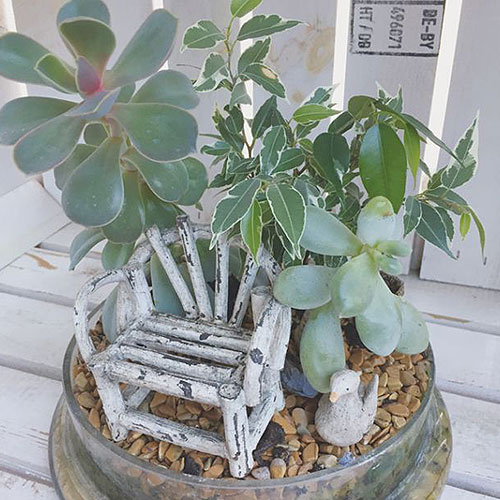
You can also put your plants in separate pots and line them up in a container to look like they are all potted together. That way, if one plant dies, or if you want to replace or reposition a plant, you can easily take it out without having to uproot and replant the whole container.
When choosing a container, you should also consider any decorative accessories that you want to add to your garden.
“You could put a unique rock or a shell on top of the soil,” Thibault said. “Or, if you plant the plants loosely enough, you can put [decorative pieces] in the soil and have them stick out.”
Thibault said terrariums in which you can construct your own miniature landscape have been growing in popularity, and so have fairy gardens, which are designed with tiny, detailed accessories to create a small-scale whimsical world.
“You can add little gravel walkways and little fairy ponds,” she said. “I know people who even make their own fairy furniture. There’s a ton you can do with it.”
Pick Your Plants
Once you decide whether you want a long-term or short-term garden and you pick out a container, it’s time to select your plants.
The most important thing, Cole said, is to choose plants that fit your lifestyle.
“Don’t buy a plant just because you like it. You may like a certain plant, but if it needs light and your house doesn’t get any natural sunlight, [the plant] is not going to do well,” he said. “You’ll have a better chance at succeeding if you think about your location, the plant’s light requirements and if the plant’s watering frequency suits your schedule.”
After you narrow the selection down to plants that will thrive in your home, look for plant varieties with similar sunlight and watering needs. For example, Cole said, you can combine ephemeral flowers like daffodils and tulips, which won’t require long-term care; cacti and succulents, both of which require little water; and house-hardy plants like peace lilies and African violets, which can survive in a home without a lot of sunlight.
“People will put a cactus with a regular plant … then say, ‘This didn’t survive,’” Thibault said. “You have to keep plants together that live in the same kind of environment. Otherwise you’ll have one growing plant but you’ll cook the other one.”
Planting & Maintenance
You should do some research on how big your plants will grow.
“You don’t want to cram too many plants into a container,” Cole said. “Make sure you give them some space, because once they start to grow, it can get overcrowded very quickly.”
Look for potting soil that is geared toward indoor container plants, as opposed to garden soil, which is used for outdoor gardening. A traditional potting soil will work for most plants, but be aware that there are some plants, such as orchids, that require a soil with more drainage.
If the container you’ve chosen doesn’t have drainage holes, or if you tend to overwater your plants, put some small rocks in the bottom of the container before adding the soil.
“It’s never a bad idea to include rocks,” Cole said. “That way the soil isn’t sitting in water and keeping the plant wet longer than necessary.”
How deep the root ball goes into the soil varies per plant and is usually specified with the plant’s instructions. As a rule of thumb, Cole said, leave a half-inch of space between the top of the soil and the lip of the container so that when you water the plant, there is some space for the water to collect. Finally push the soil in around the plant, not too tightly, but tightly enough so that water won’t immediately drain down to the bottom of the container.
There are two main ways to tell that your plant needs watering: the soil is dry to the touch, or the container feels lighter than usual. When you go to water the plant, check to see if it’s drooping or leaning to one side, and rotate the container if needed. Plants will always lean in the direction of the sunlight.
Lastly, if you notice any broken stems or limp leaves or flowers, pull them off.
“Don’t be scared to prune as necessary,” Cole said. “They’re plants; they will grow back.”
While outdoor gardens often require less maintenance during peak growing season, the fickleness of New England weather for most of the year can make an indoor garden seem more appealing.
“Many people find it easier to garden indoors than outdoors because they can control the environment,” Cole said. “You can still make it a true little garden and take care of it like a regular garden inside your home.”
A Walk On The Wild Side
A Walk On The Wild Side
How To Grow A Flower Garden
Written By Ryan Lessard (news@hippopress.com)
Images: Courtesy Photo
Wildflower gardens can provide beauty and natural function, and they’re not hard to maintain — but they can be difficult to start.
Creating a Habitat
Cathy Neal, a specialist in landscape horticulture with the UNH Cooperative Extension, has done a lot of research on wildflowers native to the region in an effort to create pollinator habitats and meadows that serve as habitats for other forms of wildlife.
“That includes things like selecting the appropriate species to seed but also we’ve looked at starting from small transplants, we’ve looked at different site preparation methods, we’ve looked at planting in the spring versus the fall,” Neal said.
Through that research, she’s determined the best way to start and maintain a wildflower planting.
The first step is to prepare the plot of land where you plan to plant your wildflowers. If it’s an area of lawn, she recommends placing a tarp over the area from mid-June to the beginning of September. By blocking the sunlight, that will kill the grass and other weeds growing there.
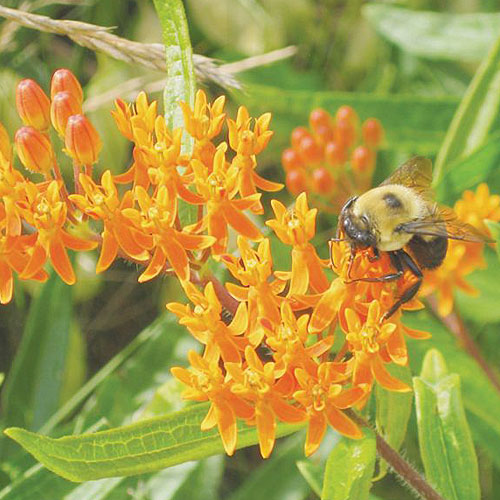
Neal said you can plant your seeds in the fall or the following spring, but there is a benefit to planting in the fall since many of the hardy wildflower species benefit from waiting through the cold of winter before germinating.
As far as obtaining the right seeds, Neal cautions against buying common wildflower seed mixes easily found in stores as they often include annuals and certain species from California and other places that won’t thrive in New Hampshire.
“We’re looking at establishing sustainable long-term native perennial wildflowers,” Neal said.
For the most balanced wildflower meadow, Neal tends to use between 13 and 25 different species. On the UNH Cooperative website, she has posted nearly 40 different native species such as black-eyed susan, common milkweed and four different types of goldenrod.
In choosing which species you plant, Neal says it’s important to pick some that bloom early in the season, middle of the season and late season.
Once you’ve got your seeds picked out and mixed together, you can spread them around by hand.
“What we do is we mix in the wildflower seed in with moist sawdust or vermiculite or I’ve heard people use kitty litter. Some of the seeds are very tiny so they stick to that carrier and spread that out and see what you got and try to get an even distribution,” Neal said.
Don’t bury them. Instead, Neal says to just rake it lightly and press the seeds in so they stay close to the surface.
Then it’s a good idea to spread a blanket of straw mulch, about a bale’s worth per square foot.
It will take probably three years before the wildflower plot is fully mature, but if you use perennials, their root structures will be stronger each year so you won’t need to worry about watering or fertilizing.
“These are plants that have very strong root systems so they’re able to grow and find what they need in the soil without us adding a lot to it,” Neal said.
Keep an eye on weeds in the first year. In mid to late July of the first year, Neal suggests using a lawnmower over the area at four to six inches high to prevent things like crab grass from going to seed while the wildflowers are still trying to establish themselves.
Worth the Effort
Wildflower plots are great for honeybees and other more native forms of pollinators, especially if they have different flowers in bloom throughout the season. And they’re still easy on the eyes.
“A lot of people want to get away from having so much lawn and manicured-type gardens. This provides a very beautiful and functional landscape component that, once you get it established, doesn’t take a lot of work,” Neal said.
It also provides benefits for stormwater management and biodiversity. Beyond pollinators, other animals might use the plants for habitat. Certain birds may like to eat the seeds when a wildflower goes to seed or use some of the stems for building nests. Some ground-nesting species may build their nest amongst the wildflowers.
Around The Garden
Around The Garden
Where To Take A Tour This Season
Written By Matt Ingersol (listings@hippopress.com)
Images: Courtesy Photo
From public and self-guided to private and personal tours, New Hampshire is home to a variety of scenic gardens. Here’s where you can find flowers blooming in the Granite State.
Bedrock Gardens
45 High Road, Lee, 659-2993, bedrockgardens.org
What: The property of what is now Bedrock Gardens was once a family-run dairy farm dating back to the 18th century. Over the last 30 years, it has transformed into a garden featuring a wide diversity of trees, shrubs and flowers, like lady slipper orchids, azaleas and more. Separate art tours are also held for its vast collection of sculptures made from repurposed farm equipment.
When it’s open for tours: Garden tours will be held the third Saturday of the month, at 10:30 a.m. and at 1 p.m., from May through September. Garden art tours will be held on the third Saturday and Sunday of the month at 1 p.m., also from May through September.
Cost: Public self-guided tours are free admission, but registration is encouraged and donations are accepted. Private tours can also be booked for larger groups that are scheduled outside of the tour dates.
What to check out: The property features 23 different distinct points of interest with opportunities to visit each one during a tour. You can check out the Funnel Garden, which is heavily planted with beautiful perennials, shrubs and trees during the season, or the “Shrubaria,” a garden of shrubs and rhododendrons under a canopy of oak trees.
Hobson Jandebeur, a docent at Bedrock Gardens, said each of the tours provides a short history of how the property has developed over time to its present state as flower and recycled art garden.
“Myself and two other people do the tours, and each has a different perspective on what they are looking at,” he said. “Later in the season when everything is fruiting, there is a whole different subject to talk about as well.”
Liz Barbour’s Edible Gardens
5 Broad St., Hollis, 321-5011, thecreativefeast.com
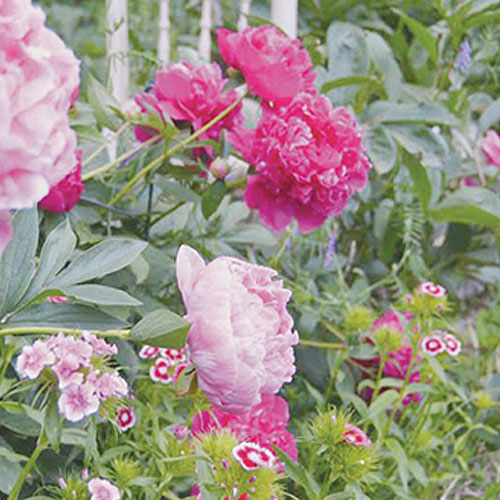
What: Chef Liz Barbour of The Creative Feast in Hollis created a cottage garden in front of her home where dozens of flowers, herbs, vegetables and perennials can be found. The garden is about a third of an acre and includes everything from begonias and daylilies to tulips, peonies and lavender.
When it’s open for tours: Sunday, June 25, noon to 4 p.m. Copies of Barbour’s new cookbook Beautifully Delicious: Cooking with Herbs and Edible Flowers will be available for sale and signing during the tour.
Cost: Free
What to check out: Barbour is known for combining different types of flowers and herbs in the same environment and showcasing unique ways to integrate them into several of her most popular recipes. Behind her house is the part of her garden she calls the “edible landscape,” which is always filled with flowers and baby greens.
Maple Hill Gardens
117 Ridge Road, Hollis, 465-7787, beaverbrook.org
What: On the grounds of the Beaver Brook Association, the Maple Hill Gardens are maintained by a group of volunteers and feature a wide variety of herbs and perennials.
When it’s open for tours: Self-guided tours are available seven days a week from dawn until dusk, now through September. Personal tours can also be scheduled by calling the Association.
Cost: Free
What to check out: Garden manager Paula Babel said visitors will find several themes at Maple Hill Gardens, with many of the more unique perennials making their appearances during the early spring. Check out Alice’s Rockery, which has bleeding hearts, wild blue phloxes, white wood asters and more. Other gardens that are great for viewing later in the year are the Autumn Garden and the Drying Gardens, which feature tall grasses and hydrangeas. The Hedge Garden, with its best viewing times from late May to mid-June, has purple irises, peonies, cranesbills and more.
Petals in the Pines
126 Baptist Road, Canterbury, 783-0220, petalsinthepines.com
What: Petals in the Pines has 26 different themed gardens and grows hundreds of varieties of flowers, including several native plants that grow on the property naturally. You can find daffodils in the spring, peonies and other perennials in the early summer and snapdragons, zinnias and sunflowers in the late summer and early fall.
When it’s open for tours: Daily from 9 a.m. to 6 p.m., from June through early September
Cost: $5 suggested donation per person, or $80 per group of as many people as you want
What to check out: Owner Donna Miller said new themes are put into the gardens every year. Check out some more kid-friendly gardens like the Peter Rabbit Garden, which is designed around the popular children’s book of the same name, or the Fairy Garden, which includes fairy houses made from natural materials. Other favorites include the Rainbow Garden, which contains a whole rainbow of colors from different annuals and perennials in season.
“People get a map when they come with descriptions of each garden, and start their path and go around to see everything that is here,” she said. “They can come on their own or in groups. … It’s a great place for garden clubs or women’s groups or even scout groups to attend.”
Tarbin Gardens
321 Salisbury Road, Franklin, 934-3518, tarbingardens.com
What: Tarbin Gardens has more than five acres of land, featuring English landscape- style gardens with a diverse variety of native and exotic trees, shrubs and perennials. You’ll find different types of flowers that are in bloom depending on the time of year that you visit, like magnolias, lilacs, crabapples or rhododendrons in the early spring, or peonies, foxgloves, roses and more during the summer months.
When it’s open for tours: Public tours are available Tuesday through Sunday from 10 a.m. to 6 p.m., beginning May 2 and continuing through early September
Cost: $8.50 for adults, $7 for children 4 and up, students and seniors, or a $25 maximum per family. Season passes are also available for $50 per person or $75 per family
What to check out: There are several different kinds of viewing areas, like the Formal Garden, which contains begonias, fuchsias and hemlock seedlings, the Catalpa Garden, where you’ll find a blooming display of spring bulbs in early May and foxgloves, campanulas and more in the summer, and the Mother’s Day Garden, which has benches for viewing and relaxing underneath the canopy of a large willow tree.